Wall St. Friends of Gina Are Giddy To Get Millions From RI Pension Fund for Doing Absolutely Nothing
Ted Siedle, Guest MINDSETTER™
Wall St. Friends of Gina Are Giddy To Get Millions From RI Pension Fund for Doing Absolutely Nothing
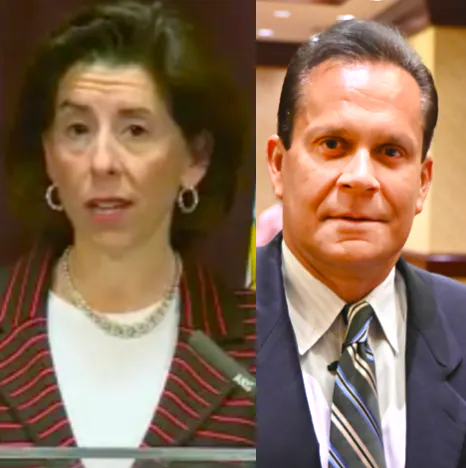
L-R U.S. Commerce Secretary Gina Raimondo, Top Wall Street Whistleblower Ted Siedle PHOTOS: GoLocalWhen Gina Raimondo pushed through so-called pension reform in Rhode Island, she neglected to tell the public that her plan to shift pension investments from low-cost traditional funds to speculative hedge and private equity funds would result in massive fees paid to her Wall Street supporters. Pension fees exploded from $10 million, pre-Gina, to over $188 million - annually!
That equated to billions (with compounding) over the past decade-plus. Slashing COLA benefits and transferring wealth to Wall Street was the secret plan that I first exposed in 2013. In addition to being outrageously high, the fees these alternative investment funds charge are questionable.
Among the many controversial practices related to private equity and debt investing are the (1) charging of investment management fees on 100 percent of “committed capital,” but (2) only reporting performance on invested or “called capital.” These are matters about which legendary investors Warren Buffett and Charle Munger have repeatedly criticized the industry, including during Berkshire Hathaway Annual Meetings and Reports.
With respect to charging fees on committed capital, after the investor makes a capital commitment to a private fund, management fees are charged on the entire commitment amount, regardless of whether the capital is actually drawn or invested. Paying fees on committed, uninvested capital results in exponentially greater fees on assets under management on a percentage basis.
For example, imagine the Employee Retirement System of Rhode Island contractually agrees (commits) to invest $100 million (capital) in a private fund over the next ten years, but only actually deposits $10 million into the fund early on. If the fee is 2 percent annually on committed capital (including the uninvested amount of $90 million), ERSRI will be charged fees of 2 percent annually on $100 million or $2 million, not 2 percent of $10 million or $200,000—even though the adviser is only actually managing (investing) $10 million of the pension’s assets initially. Note that in the example, 2 percent on “committed, uninvested capital” equates to an astronomical fee of 20 percent of the $10 million actually invested initially.
Fees on committed, uninvested capital amount to paying managers for doing nothing—no service whatsoever is provided in exchange for the lavish fee. In our opinion, such fees add insult to injury since these types of investment funds already charge exponentially higher fees than traditional stock and bond managers. For example, the bulk of private capital funds—82 percent—charge performance fees (aka “carried interest”) of 20 percent, in addition to asset-based fees of 2 percent, as well additional operational and organizational fees.
In 2017, reportedly 91 percent of private equity buyout funds and 50 percent of private credit managers demanded investors pay fees today on money investors had committed to invest over time, say, over the next 10 years. According to a more recent 2023 Private Credit Fees and Terms Study, only a small portion of management fees (5 percent) are paid on committed capital, generally for newer funds. However, 59 percent of private capital management fees are paid on half-committed/half-invested capital. In other words, 64 percent of private credit fees include fees on committed capital.
Not surprisingly, unlike ERSRI, savvy institutional investors are increasingly resisting paying lavish fees to private managers based upon their capital commitments and opting for alternatives that do not charge such fees.
According to ERSRI's Financial Statements as of June 30, 2023, the pension had $1.5 billion in unfunded commitments related to its investments. (It is possible the true number could be greater due to fund of funds and other structures that impose multiple levels of fees.)
Fees on committed capital generally range from 1.56 percent to 2 percent. Assuming ERSRI pays fees of 2 percent on total unfunded commitments, this amounts to an estimated annual waste of approximately $30 million--annually!
While Gina, her political successors and friends on Wall Street may view $30 million paid for nothing as acceptable, I doubt state workers and retirees who have seen their pension benefits slashed over the past decade-plus feel quite so generous.
Enjoy this post? Share it with others.
Translation service unavailable. Please try again later.