


Whitcomb: Tropical-Air Trials; It’s So Easy to Cheat; Resentful Judge
Robert Whitcomb, Columnist
Whitcomb: Tropical-Air Trials; It’s So Easy to Cheat; Resentful Judge

“’People have been trying to kill me since I was born,’
a man tells his son, trying to explain
GET THE LATEST BREAKING NEWS HERE -- SIGN UP FOR GOLOCAL FREE DAILY EBLASTthe wisdom of learning a second tongue….
It’s called ‘Psychological Paradigms of Displaced Persons….’’
“Immigrant Blues,’’ by Li-Young Lee, ( born 1957), American poet. He was born in Jakarta, Indonesia, to Chinese parents.
“Summer is drawn blinds in Louisiana, long winds in Wyoming, shade of elms and maples in New England.’’
-- Archibald MacLeish (1892-1982), American poet, diplomat, speechwriter and lawyer
“Sobriety diminishes, discriminates, and says no; drunkenness expands, unites, and says yes.”
-- William James (1842-1910), American philosopher and psychologist
“Do not ask me to be kind; just ask me to act as though I were.’’
-- Pierre-Jules Renard (1864-1910), French novelist, playwright and diarist

While air-conditioning is wonderful, I still sometimes miss the heat-induced indolence of summers past in New England, when few houses had AC. We’d go to the movies, big department stores, or restaurants (though only some had AC) to cool off. But much of the response to a heat wave was, after work, simply to loll around on back porches and swig the likes of Orange Crush or Miller High Life, and, if we talked at all, to do it slowly, maybe with a staticky radio broadcasting a baseball game. But no chewing tobacco.
The hype in the news media about last week’s heat wave might suggest that such hot spells are unusual in New England. Of course they aren’t! I particularly remember the one in 1975 that killed a lot of people, as temperatures climbed as high as 107. It was the hottest day yet recorded in New England. But it seems that the biggest effect of global warming around here is to make winters shorter.
News media, especially TV and online, love hot-weather stories because they get to use a lot of free video displaying sweaty faces, people guzzling ‘’spring-fed’’ water from plastic bottles, kids jumping off bridges into polluted canals or frolicking in the water via fire hydrant spray caps in inner-city streets.
You probably have seen stories about Europe’s intense heat waves. They’re particularly brutal because they have much less air conditioning than we do, though they’re trying to catch up. That means using a lot more electricity than they would have used 50 years ago. European nations are intensifying their move into renewable energy, and setting aside some reservations about nuclear power, in part because of global warming. They certainly don’t want to depend on Russian gas.
Many French people have opposed air conditioning on masochistic or aesthetic principles. But reality bites!
When we lived and worked in Paris in the 80’s, virtually no one, including the rich, had A/C in their homes.
Anti-Academic-Integrity AI
“I pledge my honor as a gentleman that I have neither given nor received aid on this exam.’’
In the Connecticut boys' school I attended in the early and mid ‘60’s, that’s what we had to write on the first page of the “blue books’’ in which we scribbled our answers to the exam questions. The exams were mostly unsupervised, with a teacher strolling in every few minutes to make sure everyone was still alive.
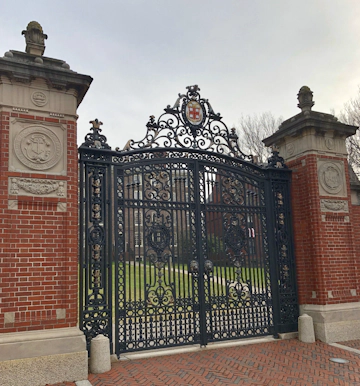
I had these quaint memories after reading GoLocal’s story on what appears to be massive cheating via using ChatGPT in an economics course on a “take home’’ exam at Brown University, and the que sera, sera attitude of Brown’s administration toward this scandal.
In a country where cheating from the White House on down is more and more tolerated and even encouraged, and where the pressure to achieve socio-economic success is intense, perhaps particularly so at elite institutions such as Brown, with their smart and very ambitious students, the temptations to be dishonest are intense. And artificial intelligence provides many new ways to cheat.
It’s early in the AI boom/nightmare, and who knows what sort of new measures can be taken to reduce academic cheating. But banning take-home exams would be a start. Monitoring long papers, as opposed to exams, might be a tougher challenge.
xxx
I guess you have to give credit to Rhode Island Gov. Dan McKee for persistence and/or courage as he continues his seemingly doomed campaign for the Democratic nomination against Helena Foulkes. While some citizens may admire his endurance, the same ones may change their minds again while navigating the confusing labyrinth at the eastern end of the Henderson Bridge. It reminds them of the Washington Bridge fiasco on Route 195 just to the south.
Also, many voters rightly think that, at 75, Mr. McKee is too old to have another term. He’s an example of the gerontocracy that runs too much of America. Mrs. Foulkes is 61. Of course, some old people are great leaders. Bruce Sundlun (1920-2011), was a very effective (and entertaining!) Rhode Island governor in 1991-1995.
xxx

The Providence-to-Newport warm-weather ferry service (June 12 to Oct. 12) offers one of the most pleasant cooling summer experiences you can have, and it helpfully keeps some cars off the road.
The service is a treasure, and I wish it could be expanded. Here’s how to get tickets and other information.
Swelling Dictatorship
Is America really a democracy now?
But the Founders were scared of democracy!
Regarding the just-ended U.S. Supreme Court term: Yes, Trump lost his attempt to keep his illegal tariffs, to fire a member of the Federal Reserve Board (for now), a mail-in ballot case, and (for now), his unconstitutional attempt to revoke birthright citizenship.
But all in all, his campaign to become an awesomely avaricious dictator is moving along at a good clip, with the aid of the far-right majority that controls the court. Consider that Scotus (basically a Republican subsidiary) has just made it even easier for powerful very rich people to, in effect, buy elections. The justices did this by striking down a federal law limiting the money that political parties can spend in coordination with candidates. The Republican Party, in which billionaires have vast political power (more than they have with the Democrats) and use it to further expand their wealth, hated that law.
And also consider the attack on “independent” agencies that were created by Congress with the idea that they’d be generally free from political pressure from presidents. Scotus has thrown out 90 years of precedent and now lets presidents fire at will the heads of these agencies, which have been staffed with nonpolitical and technically trained (many in science and engineering) people and often led by them.
You can bet that Trump will put in his lackeys to run all the agencies to his and their financial and political benefit.
Still, I hope that whoever ends up running these organizations, in between feathering their nests, will find many ways to simplify regulatory language and jettison duplicative and outdated rules.
xxx
The court’s two most extremist members are Samuel Alito and Clarence Thomas. Perhaps not entirely coincidentally, they are also recipients of large gifts from very rich Republican campaign contributors. But the other four Republicans on the court are also on the take in various ways. Hey! It’s “the magic of the market!’’
Anyway, Peter Canellos’s new book, Revenge for the Sixties: Sam Alito and the Triumph of the Conservative Legal Movement, is a brilliant look at how early social resentments can, along with nostalgia for a supposedly better time, form legal stances. In Justice Alito’s case, it’s his apparently happy memories of growing up as a bright kid in a tight-knit Italian-American family in and around the former manufacturing center of Trenton, N.J., in the ‘50’s and early and mid ‘60s, with the local Catholic parish sort of the epicenter. (Nothing about sexual abuse by priests.)
Following that was his disgust at what he saw as the libertine actions and words and lack of patriotism by his fellow students at Princeton, many of whom he understandably considered spoiled by social privilege; some were. He said: “I saw some very smart people and very privileged people acting irresponsibly.’’ Now he’s very privileged himself and taking full advantage of it.
His anger at anti-Italian-American bigotry was justified!
I don’t remember the ‘50’s and early ‘60’s as quite so wonderful. Certainly, it wasn’t for such minorities as Black people and gays, and air and water pollution were horrific in those pre-days of the EPA, which Trump (whose power Mr. Alito seeks to steadily expand) hates. Sam Alito seems to have never had much interest in the rights of minorities.
Mr. Canellos, an acclaimed author and journalist, and trained as a lawyer himself, brilliantly explains how the very smart and hard-working Sam Alito’s early years explain much of his reasoning/apologias as an oft-bitter judge. Some of his legal thinking seems quite reasonable/rational, but some of it is rife with intellectual contradictions, contortions and hypocrisy.
Mr. Canellos gives us very useful lessons in how federal courts work and the various ways judges think as they prepare their opinions. And we learn how the “conservative” Federalist Society came to have such power in our courts. Classic American conservatism strongly backed the separation of powers and restraints on presidential power. But many in the Federalist Society have supported giving the presidency almost Fascistic powers. Doesn’t sound very conservative.
Anyway, this is a terrific book, maybe especially in an election year.
British Doing Themselves In
A new article in The Atlantic, “How Britain Became as Poor as Mississippi: A Case Study in Self-Sabotage,’’ has lessons for America.
The article details the nation’s under-investment in social services and physical infrastructure, erratic and oft-incompetent fiscal and other leadership, and right-wing “populist” MAGA-style xenophobic demagoguery leading to Brexit, which has been an economic disaster. Of course, such techno advances as social media, which are misinformation and disinformation machines, have made things worse as leaders try to conduct public policy amidst an always churned-up and confused public.
Then there’s letting the country become too dependent on the vagaries of the financial sector based in London – a sector that has come to include, since the ‘90s, too many foreign crooks, most notably Russian oligarchs.

Downeast Dilemma
The U.S. Senate race in Maine between “progressive Democrat’’ Graham Platner and the incumbent Republican, Susan Collins, must be the most interesting in the country. Mr. Platner, 41, an oyster farmer (and former preppy)_ with a complex background, including as a combat veteran with PTSD, has a reputation for being a wild man – an image he’s urgently trying to reduce. He appeals to the anger of millions about the corruption of the plutocratic near-dictatorship in Washington, and the relative youth he’d bring to the geriatric Senate is attractive to many.
Senator Collins, 73, for her part, has rarely evidenced any strong sense of ethical principle in her long career. She’s a moral cipher. And she votes for Trump-backed legislation more than 90 percent of the time – interesting in a state more blue than red.
Her aim has always been simply to remain in office as long as she can. To do this, she has provided solid constituent services, including winning highly lucrative federally funded projects for the Pine Tree State. Indeed, I wouldn’t be surprised if Trump, in the next couple of months, promises Maine a new bridge or two in the watery state, or a couple more Navy ships to be built at the Bath Iron Works shipyard.
If she wins again, her promise to bring home a lot more bacon will have a lot to do with it.
The senator has another big advantage: She remains very popular in Aroostook County, a conservative, MAGA-inflected region where she’s from. Mr. Platner’s support is strongest in coastal areas and cities, especially among younger voters. They’re more likely to sympathize with his emotional problems, past and present.
So Susan Collins is boring and Graham Platner is exciting – but too exciting for many.