


PPS Calls on Brown to Halt Demolition of 4 Historic Houses — University Has Demolished 150+ Buildings
GoLocalProv News Team
PPS Calls on Brown to Halt Demolition of 4 Historic Houses — University Has Demolished 150+ Buildings

Providence Preservation Society has issued a statement calling on Brown University to “pause the RFP process and project planning to explore an adaptive reuse solution on this site, given both the irreversibility and the measurable environmental costs of demolition and new construction.
Brown is pushing forward to tear down four multi-family homes on Brook Street. Providence is in a housing crisis.
GET THE LATEST BREAKING NEWS HERE -- SIGN UP FOR GOLOCAL FREE DAILY EBLASTThe non-profit organization cites the architectural value of the homes and says Brown’s history has been to demolish homes. The group identifies that since 1945, Brown has torn down more than 150 buildings.
“To proceed with this project, Brown must amend its 2023 Institutional Master Plan with approval from the City Plan Commission (CPC). PPS has been told by University staff that Brown plans to appear before the CPC in September, October, or possibly later. The University has begun preliminary planning and issued a request for proposals (RFP) with a spring due date to a select number of firms to submit proposals for this development, said PPS.
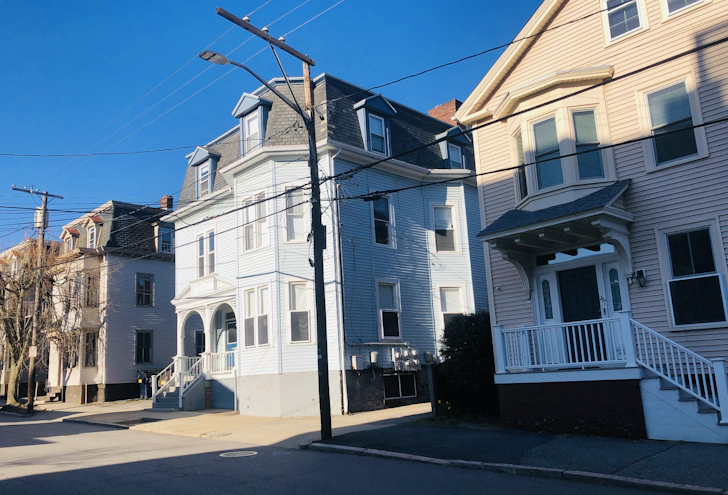
Brown Expansion - Would Destroy Historic Properties
PPS Cites:
The buildings slated for demolition include two residences built for Frederic Fuller in the 1870s at 277 Brook Street and 281-283 Brook Street, and two residences built for Alexander Gorham in the 1880s at 287 Brook Street and 291 Brook Street. All four residences are listed as contributing buildings in the National Register of Historic Places’ College Hill Historic District for their architectural significance.
Fuller’s father founded Fuller Iron Works at the Fox Point Foundry in 1840 before constructing a state-of-the-art steel frame and glass machine shop on South Main Street in 1893. Gorham (1836-1914) was a Black real estate developer who inherited the land on Brook Street from his father; he and his wife Caroline were also philanthropists who supported Black charities, including the Home for Aged Colored Women and the Home for Colored Orphans. Brown University purchased all four residences in the 1980s and 1990s.
Smiley v. Morales
The demolition of the homes has become an issue in the mayoral race. Providence Mayor Brett Smiley has refused to take a stand. State Representative David Morales has called on Smiley to preserve the homes by taking them by eminent domain.
Urging Reuse
“PPS urges Brown to adapt and add onto the existing buildings for this new department to retain a connection to the site’s history, protect the residential look and feel of the neighborhood, and diminish the environmental costs of demolition and new construction,” said the group.
PPS states:
Buildings contribute to greenhouse gas emissions through their operational carbon needs (the building's energy use) and through their embodied carbon (emissions released in the manufacturing, transportation, installation, maintenance, and disposal of building materials). Massachusetts' Embodied Carbon Reduction Plan, published in January 2026, states: "Embodied carbon (EC) is the sleeping giant when it comes to sources of climate pollution...the most effective ways to lessen EC impacts are to reduce overall volumes of new work through building and material reuse and scoping capital investments to only the size needed to meet needs, avoiding unnecessary construction." Additionally, the Natural Resources Defense Council (NRDC) reports that “over the next 25 years, more than half of the emissions from new buildings will come from the materials that make up a building, rather than its operations.”
Brown has adaptively reused (and even relocated) historic buildings in the past. PPS calls on Brown to pause this project in order to evaluate the embodied carbon emissions and possible cost savings associated with an adaptive reuse approach on this site.
PPS also recommends that Brown track the volume of construction and demolition debris that is produced as a result of its development projects, and report to the public on its final dispensation, including how much was salvaged and reused, recycled, or sent to the landfill. In every project involving demolition or major renovation, PPS urges Brown to produce a deconstruction plan – a key aspect of circular economy practices – to ensure that building materials can be salvaged and reused.
Lack of Transparency By Brown
Further, PPS calls on the University to become more transparent:
Brown has not provided PPS with demolition numbers, but we estimate that the University has razed more than 150 buildings since 1945. About a third of these demolitions included historic houses on Brown, George, Benevolent, Charlesfield, and Thayer Streets that were taken down to make way for a single project in the early 1950s: Wriston Quadrangle. In scale, the Wriston redevelopment project alone demolished the same number of buildings as the city’s first urban renewal project, the Point Street Renewal Project (1950-1961), which razed 53 structures. The Weybosset Hill Redevelopment Project downtown, carried out from 1960 to 1981, demolished about as many buildings as Brown has demolished over the last 80 years. The only other private or nonprofit institution that has demolished city buildings at this scale is potentially Rhode Island Hospital, now Brown University Health.
While pieces of Brown’s development impacts have been uncovered by individual researchers and writers, including Brown students and faculty, the University itself has not comprehensively acknowledged or documented this history. This report should include a survey of the properties that have been demolished by Brown and an account of how many of these properties were associated with Black history on College Hill, as this aspect of Brown’s clearance and redevelopment history has not been adequately addressed by Brown.
To give one example of this history: Brown purchased the Bethel AME Church at 193 Meeting Street in 1961 and demolished it five years later. The Church originated in 1795 as the African Freemen’s Society and met in the Quaker Meetinghouse on North Main Street and in private homes until they were able to construct the Bethel AME Church in 1866. The demolition took place after Brown stated that “there will be no severe alterations, and the use will be by some department whose functions will be in keeping with the long use of the building as a place of worship.”
Other universities and institutions in Providence and throughout the country have similarly complex histories of expansion, displacement and harm – including PPS, which we have documented and continue to report on. It is time for Brown to do the same.