Brown and Bryant Receive Tens of Millions From “Countries of Concern” According to New Government Data
GoLocalProv News Team
Brown and Bryant Receive Tens of Millions From “Countries of Concern” According to New Government Data

A new reporting system launched by the U.S. Department of Education (USDOE) requires colleges and universities to disclose the sources of revenue from foreign interests.
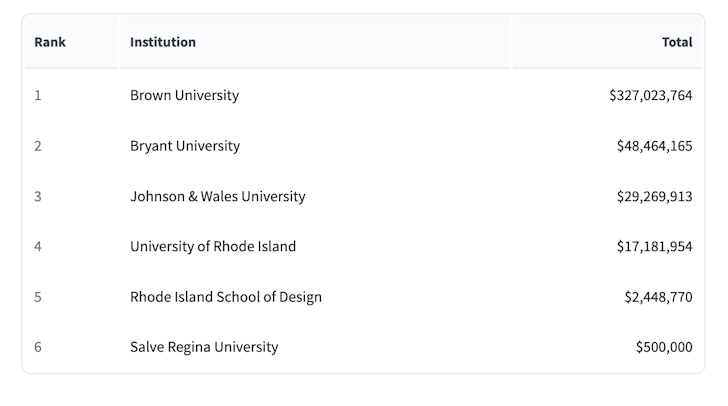
Brown and Bryant universities combined received nearly $400 million and more than $100 million from “countries of concern.”
The USDOE recently unveiled the new reporting requirement. “The U.S. Department of Education (the Department) released data compiled from foreign funding disclosures submitted by American colleges and universities for 2025 – documenting over 8,300 transactions worth more than $5.2 billion in reportable foreign gifts and contracts. These disclosures are required by Section 117 of the Higher Education Act (Section 117), which obligates universities receiving Federal financial assistance to disclose foreign source gifts and contracts with a value of $250,000 or more annually to the Department."
GET THE LATEST BREAKING NEWS HERE -- SIGN UP FOR GOLOCAL FREE DAILY EBLASTSEE HOW MUCH THE OTHER RI COLLEGES AND UNIVERSITIES RECEIVED BELOW
The new disclosure structure specifically breaks out not only funds from “countries of concern” but also “counterparties of concern.”
The U.S. Department of Education (ED), in partnership with the State Department, monitors "counterparties of concern"—foreign governments, entities, or individuals—to identify risks to national security in higher education. Under Section 117 of the Higher Education Act, institutions must report gifts or contracts over $250,000 from these sources.
Bryant ranks second in the United States for receiving funds from “counterparties of concern."
Overview
Brown has received $327,023,764 in foreign funding — from 1,077 transactions,
A significant amount of the funds derives from China, a country designated as a country of concern.
China-linked money accounts for $61,431,703 of Brown’s funds — 158 transactions.
Bryant receives nearly all of its monies from China — a country of concern — and nearly all of those monies are tied to counterparties of concern.
Bryant Received More than $44 Million from China and Counterparties of Concern
According to the USDOE data, Bryant has received all of its foreign money from China — a total of $48,464,165
Almost all of that money from China came from counterparties of concern.
The U.S. Department of Education (ED), in partnership with the State Department, monitors "counterparties of concern"—foreign governments, entities, or individuals—to identify risks to national security in higher education. Under Section 117 of the Higher Education Act, institutions must report gifts or contracts over $250,000 from these sources.
Bryant is second only to MIT in accepting monies from counterparties of concern. Bryant did not respond to requests for comment.


Bryant's Ties to Chinese Funding
In 2020, Bryant refused to answer questions from GoLocal.
GoLocal reported in 2020:
There is growing criticism by both Republican and Democratic members of Congress about the influence of Chinese “education” programs on college campuses across the country via the Confucius Institute.
The programs have been criticized as being centers for espionage, tools for the Chinese government to control dissent, and structures for developing strategies to collect intellectual property. Most of the programs are funded in whole or in part by the Chinese Ministry for Education.
In late 2018, the University of Rhode Island announced it was ending its relationship with the program. The announcement came just months after GoLocal sought thousands of emails tied to the Director of the Confucius Institute at URI — Dr. Wayne Wenchao He.
“In order for us to be consistent with the intent of the United States John McCain National Defense Authorization Act, which had some specific limitations,” Clifford Katz, the acting director of the Confucius Institute at URI, said. “We decided on December 1 that we were going to dissolve our Confucius Institute and terminate our relationship with the Chinese organization known as Hanban, which supports Confucius Institutes.”
Bryant University officials refused to respond to repeated phone calls and emails from GoLocal about the Confucius Institute in Smithfield.
The Confucius Institute program director at Bryant, Dr. Hong Yang, also refused to respond to questions.
Then, in April of 2021, Bryant announced it was ending its partnership with Confucius, “After 15 years of valued language and cultural programs provided through the Confucius Institute at Bryant, the University has chosen not to apply for continued funding at the expiration of the Confucius Institute contract. Bryant will evaluate changes that are taking place in China and regarding U.S.-China relations before making any future commitment.”
Top Recipients Nationally
According to USDOE, "The most recent disclosures from 2025 identify Qatar (over $1.1 billion), the United Kingdom (over $633 million), China (over $528 million), Switzerland (over $451 million), Japan (over $374 million), Germany (over $292 million), and Saudi Arabia (over $285 million) as the largest foreign sources of reportable gifts and contracts to American universities (including both state and non-state entities)."
"The top university recipients of those foreign funds are Carnegie Mellon University (almost $1 billion), the Massachusetts Institute of Technology (almost $1 billion), Stanford University (over $775 million), and Harvard University (over $324 million). Additionally, between February 28, 2025, and December 16, 2025, more than $2 billion in reportable gifts and contracts were reported late, in direct violation of statutory requirements," adds USDOE.
Other Rhode Island Schools