


RI, The Incredible Shrinking State — Population Is Significantly Declining, Says New Report
GoLocalProv News Team
RI, The Incredible Shrinking State — Population Is Significantly Declining, Says New Report
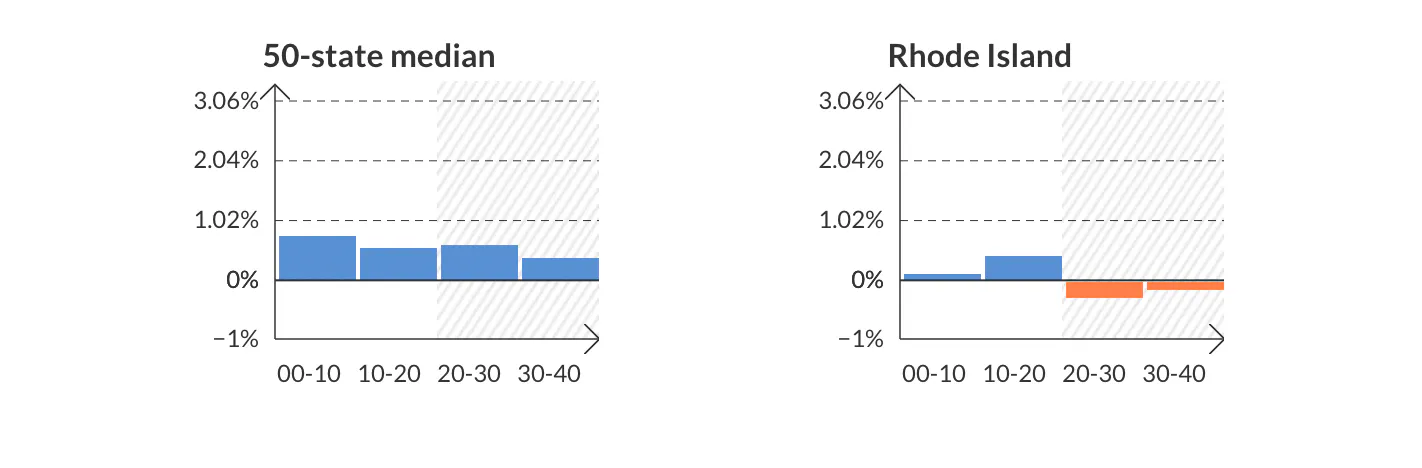
The report issued by Pew Charitable Trust finds that from “2020 to 2030, Vermont, West Virginia, and Rhode Island are projected to shrink the most, while Texas and North Dakota are projected to grow the fastest.”
The population trend is expected to continue the decline for at least another decade straight through to 2040. Pew has not issued a projection beyond 2040.
GET THE LATEST BREAKING NEWS HERE -- SIGN UP FOR GOLOCAL FREE DAILY EBLAST“In the 2020s, Rhode Island is one of the eight states with projected decreases in population. And in the 2030s, Rhode Island is one of the 11 states with projected decrease,” states Pew’s report. Rhode Island's population as of 2022 was 1,095,962.
The Pew analysis of the decennial population data from the U.S. Census Bureau and the national population projections from the University of Virginia Weldon Cooper Center.
The Pew study has a profound implication on everything from the number of schools Rhode Island will need, the size of the workforce, and the amount of housing that needs to be built.
Presently, Rhode Island has a shortage of housing units, but maybe equally or more importantly, is a crisis of affordability. The median asking price of a single-family home in Rhode Island is now $499,000. Many of Rhode Island's homebuyers -- about 20% are from out of state and many are working in Boston, working remotely or buying a vacation home.
A study released in 2022 by the U.S. Census Bureau identified Rhode Island as one of eight states that were overcounted in the 2020 census, which will be used for the next decade to allocate congressional seats and federal money.
Growing Population, Growing Economies
There is a lot of research on the correlation between the growth of populations and whether it drives economic growth.
Joanna Biernacka-Lievestro, a senior manager with The Pew Charitable Trusts’ Fiscal 50 project, states, “More people usually means more workers and consumers contributing to economic activity as they take jobs and buy goods and services, which generates more tax revenue. A growing economy, in turn, can attract even more workers and their families.”
“On the other hand, a shrinking or slow-growing population can be both a cause and an effect of weakened economic prospects. Less economic activity can limit state revenue collections. And although a smaller population can lead to a reduction in some spending, it also means fewer residents are available to help cover the costs of long-standing commitments, such as debt and state employee retirement benefits. The size of a state’s population, and annual changes to it, also factor into how much it will receive from some federal grants,” added Biernacka-Lievestro.
But in contrast, Liu Qing of the University of Iowa says there is no correlation and says the factor that drives the economy is the talent of the workforce.
"First, high population growth is not necessarily leading to economic growth....the poorest countries in the world have high population growth but low economic growth," said Qing.
"Second, human capital growth is the key to economic growth of the modern era after the Industrial Revolution. In the pre-industrial revolution era, human beings are trapped in the Malthusian stagnation. After the industrial revolution, the economic treasure created within 200 years is more than the total that is created before the revolution. Accompanying this growth transition is the decline of fertility rate. We are entering the modern mode of economic growth and population growth. The key to the economic and demographic transition is the technology advancement generated by human capital growth, in turn, triggered by the large size of population. Therefore, the key is not the size of the population, and it is the high-quality labor that matters the most."
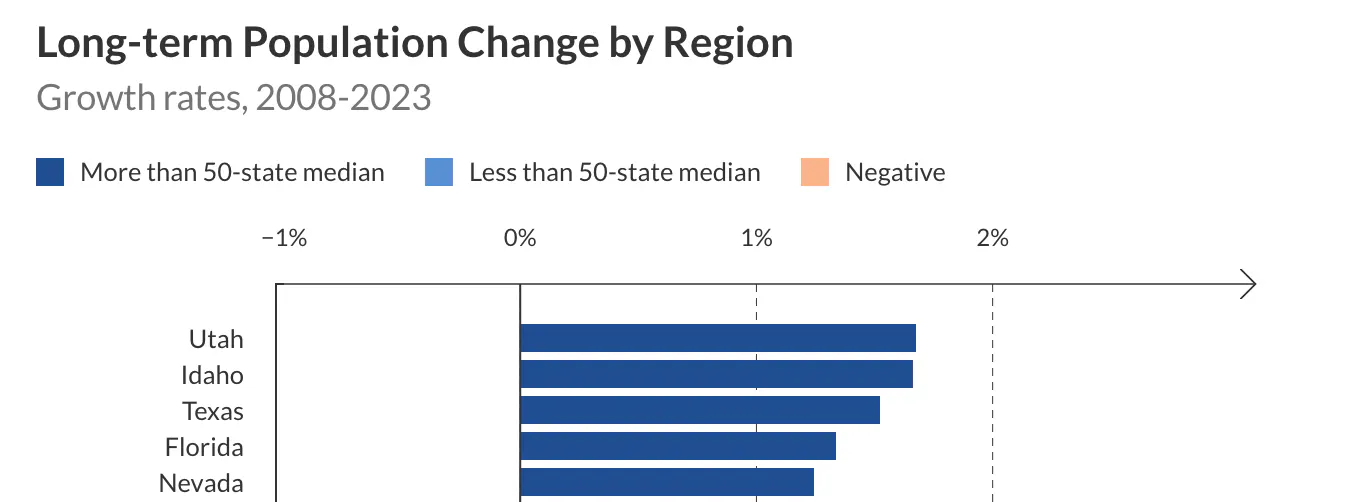
The states that are presently growing the fastest can be seen below.
National Trend
“According to the center’s projections, growth is likely to remain tepid through 2040 with the national population forecasted to grow at about the same pace from 2020 to 2030 as the prior decade—already the slowest on record—before dropping to new lows from 2030 to 2040. In the 2020s, 31 states may face population slowdowns compared with the previous decade, and the number climbs to 45 in the next decade,” writes Pew.
“The Census Bureau also projects that nationally, population growth will remain moderate at best and largely attributes that forecast to declining fertility rates combined with rising death rates as baby boomers age,” adds Pew.
The Congressional Research Service (CRS) in March reported that the U.S. growth rate is declining substantially.
“From 1977 through 2008, the U.S. population grew 1% per year on average. From 2009 through 2022, average population growth fell to 0.5% per year. According to the recent Census projections, population growth will fall from 0.49% in 2023 to 0.25% in 2038, before falling to 0.002% in 2080 and turning negative in subsequent years. Greater longevity and falling birth rates together result in the aging of the population,” according to CRS.
And CRS points out, “Yet, long-term population projections are subject to considerable uncertainty. Some demographic components, such as the aging of current cohorts, are more predictable, while others, such as future fertility rates and net immigration, are less so. Sorting out persistent effects of the COVID-19 pandemic from transitory effects also complicates such projections.”
Editor's Note: The primary Pew research was conducted by the Pew Charitable Trust.