


RI Property Taxes Dramatically Increased This Year, Says New Report
GoLocalProv News Team
RI Property Taxes Dramatically Increased This Year, Says New Report
Rhode Island property taxpayers took a big hit this year, according to a new study by the Rhode Island Public Expenditure Council (RIPEC).
And Rhode Island property owners are already facing the 10th-highest property tax levels in the nation, at $2,505 per capita in FY 2023, and 22% above the U.S. total.
The RIPEC report has little good news for anyone in Rhode Island.
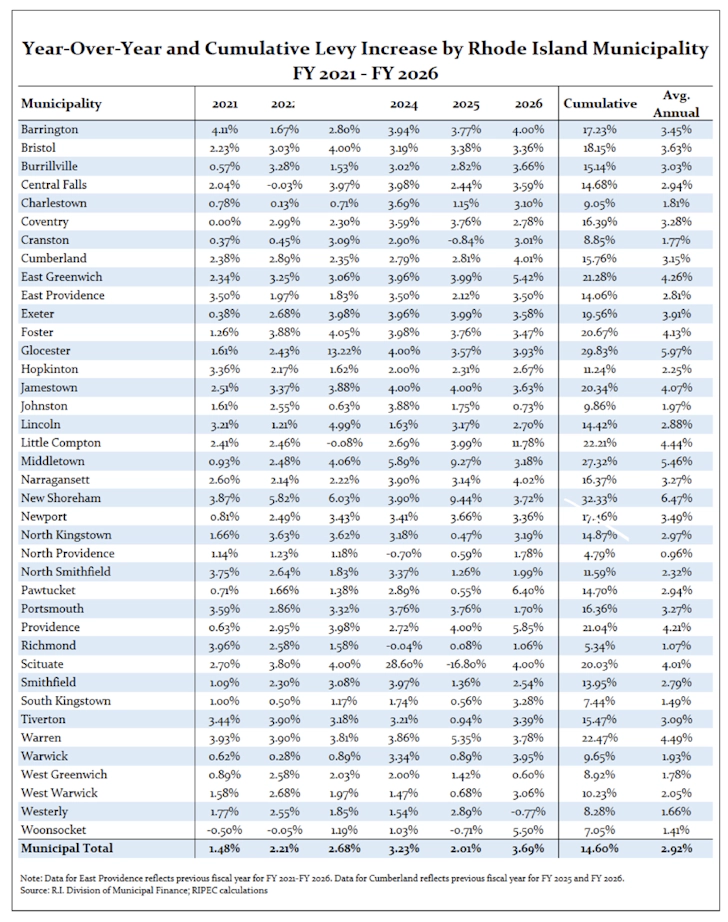
GET THE LATEST BREAKING NEWS HERE -- SIGN UP FOR GOLOCAL FREE DAILY EBLASTThe report finds, “FY 2026 marked a significant acceleration in property tax increases following several years of comparatively modest growth. The statewide municipal tax levy increased by 3.7%, or $98.3 million, in FY 2026, the largest increase in ten years and above projected inflation (2.8%).
Nearly one in five cities and towns (seven) exceeded the state’s mandated 4.0% levy cap—the highest number in the last decade and well above the prior nine-year average of 2.2 communities.
“With Rhode Island property taxpayers already facing some of the highest property tax levels in the country, it’s concerning that several communities are raising taxes beyond the 4.0% cap,” said Michael DiBiase, President and CEO of RIPEC. “When we looked at local tax trends and who is impacted the most, it became clear that cities and towns are increasingly shifting a greater share of the burden onto landlords, renters, and businesses. These patterns are most pronounced in the communities where most renters live and where most of the state’s business activity is concentrated.”
Values Surge
RIPEC also finds rapid growth in assessed property values across the state. Total values surged by $61.47 billion (42%) between FY 2023 and FY 2026; 2.5 times the growth rate of the preceding three-year period. Residential real estate drove overall growth, increasing by $55.16 billion (47%) over three years and more than doubling in value over nine years.
Commercial real estate also experienced strong growth over the last three years, though at a lower rate than residential property (26%).
Taylor Swift Tax Hitting
Property tax growth is likely to further accelerate next year with the new statewide tax on high-value, non-owner-occupied residential property, projected to generate about $25 million annually.
Businesses Impacted
RIPEC also reports that Rhode Island businesses are bearing a growing share of Rhode Island’s property tax burden. In FY 2026, the statewide effective commercial property tax rate was 54% higher than the residential rate, up from 41% in FY 2022.
Providence Commercial Property Owners Among the Hardest Hit in U.S.
In Providence, commercial property owners face the largest disparities in Rhode Island and among the highest in large U.S. cities, with commercial real estate taxed at 3.5 times the single-family owner-occupied residential rate, resulting in an annual tax bill of $29,200 on a $1 million commercial property—$20,800 greater than the tax on an owner-occupied single-family home of equal value.
Impact Adverse to Renter
RIPEC also finds that renters and landlords are increasingly affected by local tax policies that favor owner-occupied housing. Larger apartment buildings are typically classified as commercial property and taxed at higher rates in 21 municipalities. Additionally, 12 municipalities now use homestead exemptions that shift tax burdens onto non-owner-occupied properties. In some communities, this translates into an annual tax bill gap of nearly $3,000 between owner-occupied and non-owner-occupied single-family homes of equal value at the median sale price. This additional cost is often passed on to renters, who are already more likely than homeowners to be housing-cost-burdened.
“These policies are not only about fairness but also have real consequences for two of Rhode Island’s most pressing challenges: housing affordability and economic prosperity,” said DiBiase. “Property taxes account for nearly 20 percent of housing costs and about 40 percent of state and local business taxes in Rhode Island. As a result, they play a meaningful role in decisions about business formation, location, and expansion, as well as rental prices and the feasibility of building new housing—particularly the type of higher-density developments we need to meaningfully increase our housing stock.”
“These issues have been building for years without meaningful reform,” said DiBiase. “The General Assembly has provided cities and towns with very few guardrails. Given the recent jump in property taxes, which are already high, the urgency for action is even greater. The state can either pursue meaningful reforms or continue to allow tax inequities to grow, eroding affordability and economic growth.”
RIPEC Recommendations
- Maintain the state’s 4.0 percent levy cap
- Establish constitutional limits on tax rate differentials among property classes
- Move toward annual property revaluations
- Expand targeted property tax relief for vulnerable taxpayers