


Breakthrough Stroke Treatment Saving Lives in RI, Says Brown Alpert Medical School Stroke Expert
Breakthrough Stroke Treatment Saving Lives in RI, Says Brown Alpert Medical School Stroke Expert
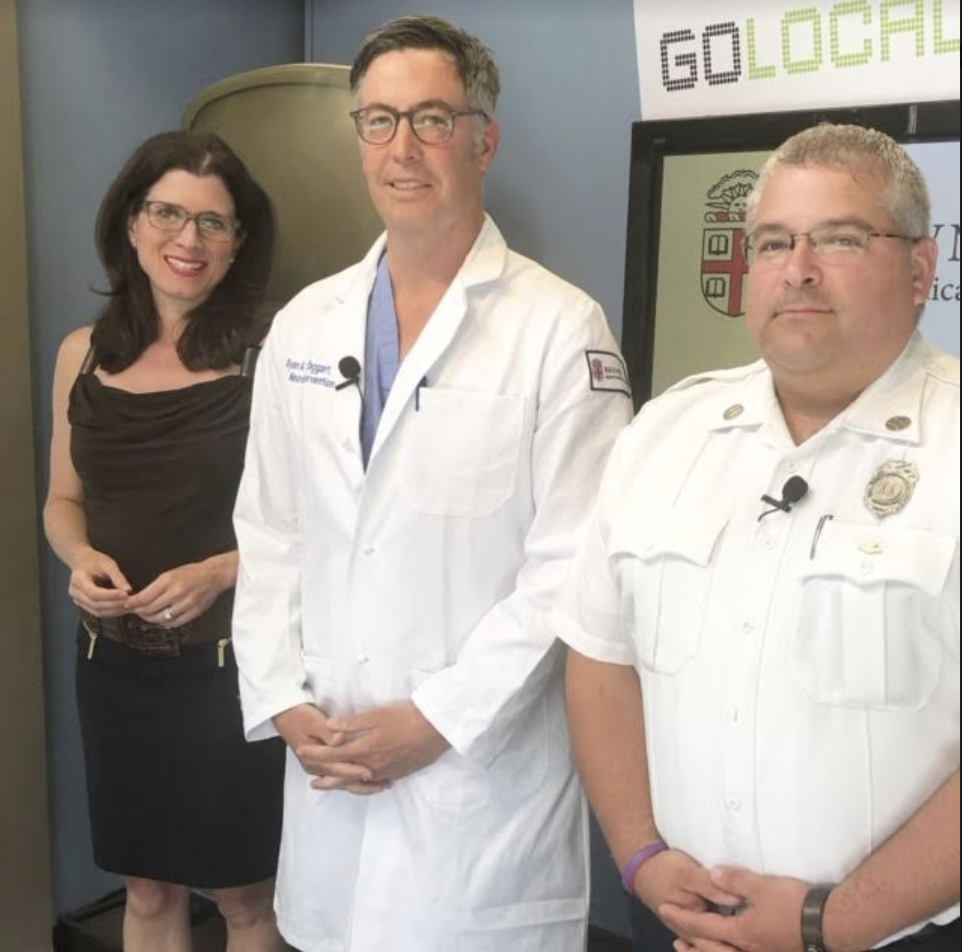
"We’ve aimed to get patients to the right place the first time," said McTaggart, of Rhode Island Hospital being one of the few hospitals in the country to perform a breakthrough in stroke treatment -- mechanical thrombectomy -- for the most severe stroke patients.
Research in Focus
“For the past three years, I’ve been focused on clinical research to increase access to a procedure mechanical thrombectomy for emergent large vessel occlusion stroke. That’s sort of a loaded sentence, so let me explain a little bit what that means,” said McTaggart.
“90% of strokes are ischemic strokes those are strokes caused by [a] blocked blood vessel. 10% of strokes are hemorrhagic strokes — or strokes caused by bleeding in the brain. A subset of those ischemic strokes — called emergent large vessel occlusion strokes — are the most devastating. And without treatment, 75% of patients will die or be severely disabled,” said McTaggart. “But we can do a surgical procedure to open those blood vessels and instead of patients being dead or disabled, we can send them home in a few days.”
“So we’ve really had a three-pronged approach to improving access to that procedure. We’ve aimed to get patients to the right place the first time. We’ve introduced protocol to improve stroke workflow in other hospitals and then we’ve improved in-hospital processes at Rhode Island Hospital. We were the first state to have a field diversion protocol which empowers EMS professionals to make a decision in the field to take patients to the level one stroke center - and Captain Potvin has been a great partner with that," said McTaggart.
“Because we’ve done so well, we’ve been the highest enrollers in several of the largest stroke trials recently — there’s a lot of great clinical research happening at Brown.”
McTaggart, an Associate Professor of Diagnostic Imaging, Neurology and Neurosurgery at The Warren Alpert Medical School, is a Neuroradiologist who specializes in Interventional Neuroradiology at Rhode Island Hospital, and has particular expertise in flow diversion for difficult intracranial aneurysms.
He was joined by Captain John Potvin with the East Providence Fire Department, who talked about how the emergency response community plays an important role in getting patients to the proper care — quickly and efficiently.
East Providence’s Potvin on First Responders
“Our number one goal is that we get the right patient to the right facility quickly and in the most efficient time. We work closely with our colleagues in the hospital as well as the Rhode Island Ambulance Service Advisory Board and the Stroke Task Force to really make sure Rhode Island has the best protocols,” said Potvin.
“Being pre-positioned in the community, I feel it is our job and our responsibility to make sure that we educate the public in what the signs and symptoms of stroke are, because I think the biggest thing is that people don’t realize they’re having a stroke, and their family doesn’t realize they’re having a stroke, so they neglect to call 911 as quickly as possible,” added Potvin.
Stroke Symptoms Explained
McTaggart explained the prevalence — and symptoms of stroke — for viewers.
“Stroke is very common. 1 in 6 people will have stoke in their lifetime, stroke happens every 40 seconds — someone dies of a stroke every four minutes. Like Captain Potvin said, no one’s going to tell you they’re having a stroke, so you have to recognize it,” said McTaggart.
“So we like to use the acronym FAST to help people remember how to recognize a stroke. F stands for facial drooping or facial asymmetry, the “a” stands for arm weakness, the “s” stands for changes in speech — someone’s speech may be garbled, they might not be able to understand what you’re saying, or produce any speech at all, and “t” of course stands for time — time to pick up the telephone and call 911. The firefighters in our state and EMS professionals are the best in the nation in my opinion under captain Potvin’s leadership,” said McTaggart.
Brown at Forefront — and Future of Research
“I can’t think of anywhere else I’d want to practice medicine and research because we have this wonderful collaboration with the university. Two high impact areas we can look for in the future is the use of artificial intelligence or machine learning to analyze data —and try to help with clinical decision making and then make downstream care delivery more efficient,” said McTaggart.
“Another exciting area is using this minimally invasive techniques that we’ve talked about to deliver electrodes into the blood vessels in the brain and that can serve as a unique neural interface whereby they can record data from the brain and even stimulate areas of the brain. That has potential implications for neurodegenerative diseases like Parkinson’s, epilepsy, and may be useful in patients that are trying to recover from a stroke and may be weak or paralyzed in one limb, and then finally may even have an impact for anxiety and depression,” added McTaggart.
“We have a terrific program — we’re delivering great clinical care — and the future’s very bright with this collaboration with Brown Medicine,” said McTaggart.