


RI’s Statues - A Glowing Tribute to White Men, Animals and Very Few Others
GoLocalProv News Team
RI’s Statues - A Glowing Tribute to White Men, Animals and Very Few Others

A GoLocal review of multiple research sources, including a more than 20-year-old and nearly forgotten state report, unveiled a number of trends and stark realities.
GET THE LATEST BREAKING NEWS HERE -- SIGN UP FOR GOLOCAL FREE DAILY EBLASTFirst, across the state, you can find tributes to men ranging from Presidents George Washington and Abraham Lincoln to Rhode Island founder Roger Williams to the late Governor and one of the newest statues, Senator John H. Chafee. Statues of Williams can be found in Bristol and multiple locations in Providence.
"Statues are symbols of who we are. Easier to read, understand, and identify with than architecture, a statue speaks of a period, of an aesthetic, and of the aspirations of the people who commissioned it," said Will Morgan, architectural critic.
"A strong statue, by virtue of how it is formed and where it is place. can be a landmark, a touchstone, or a lightning rod. And, almost all public sanctuary is political," added Morgan.
.JPG)
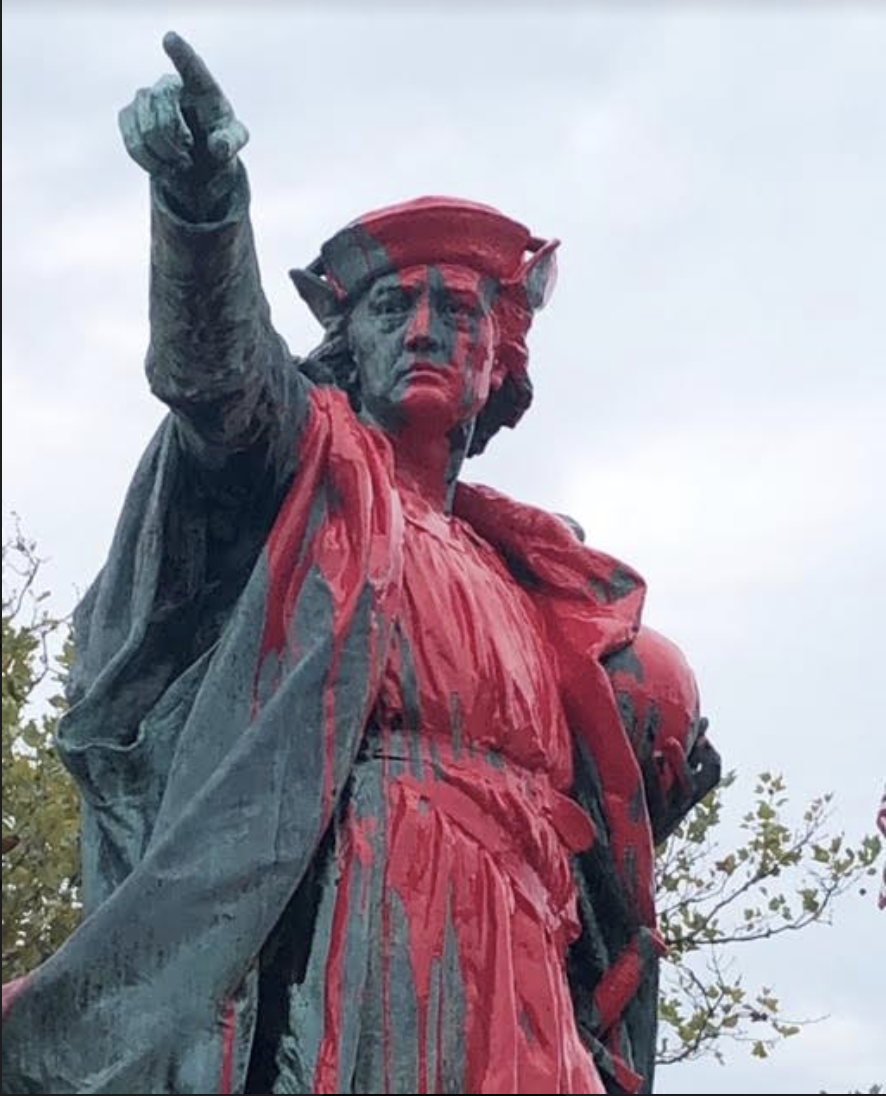
In Rhode Island and across the world there is a new focus on public art, history, and specifically, statues. Providence's Christopher Columbus has been removed from its historical location and placed in storage. The Providence Columbus sculpture was created by Auguste Bartholdi —the Frenchman who sculpted the Statue of Liberty.
The sculpture was cast in 1893 by the Gorham Manufacturing Company, which had commissioned master sculptor Bartholdi.
The Providence-based bronze cast statue is a cast of the original sterling silver statue commissioned for the 1892 Columbian Exposition of the World's Fair held in Chicago, Illinois. “For the upcoming exposition, Gorham wanted a demonstration piece to show the skill of its foundry and commissioned Bartholdi to create a statue of Columbus,” according to the Rhode Island Secretary of State’s Office.
Now there is a petition calling for the removal of Columbus' statue in Newport.
.JPG)
.JPG)
What you can barely find in a Rhode Island is a sculpture of a non-white man or a tribute to a woman who lived. There are a few sculptures that include imagery of women - but virtually no public statues of women.
On the hundreds of sculptures and statues listed in the inventory of Rhode Island's public art published in 1999, there was not a tribute to a once-living woman or a Black man or woman.
The document was produced as part of a federal initiative Save Outdoor Sculpture, a joint project of the National Museum of American Art at Smithsonian Institution and the state of Rhode Island.
"There are no [Black] statues that I am aware of. I have made inquiries into Newport and state about recognition of Rev. Mahlon Van Horne the first African Heritage person elected to RI General Assembly in 1885, but no response," said Keith Stokes.
Stokes is an advisor for Rhode Island with the National Trust for Historic Preservation along with serving on numerous regional and national historic preservation boards including Chairman of the Touro Synagogue Foundation, Vice President & Trustee of the Preservation Society for Newport County, and Newport Historical Society.
.JPG)
.JPG)
"The Emancipation Monument in Washington, DC, celebrating the Emancipation Proclamation, ending slavery, shows a freed slave thanking President Lincoln on his knee. The president’s left hand gracefully asks the freed man to rise and take his station as a freed man. No matter how one wishes to interpret this monument, it is a record of history that must continue to inspire us to advance justice in the future," said St. Florian.
At the dedication of Rhode Island’s first major public sculpture — the dedication of Benjamin Franklin, Providence sculptor Frances Hoppin expressed high hopes for public sculpture in the state.
“This is the first public statue in Rhode Island! Let it be but the beginning of a phalanx of statues! Let our heroes, our poets, our statesmen, our philosophers, and our men of worth, live among us not only in the form of their achievements, but in monuments of iron and bronze and marble, adorning our streets and parks, perpetually preaching their virtues and telling us that they once lived and acted, and were flesh and blood like ourselves," wrote Hoppin.
_1.JPG)
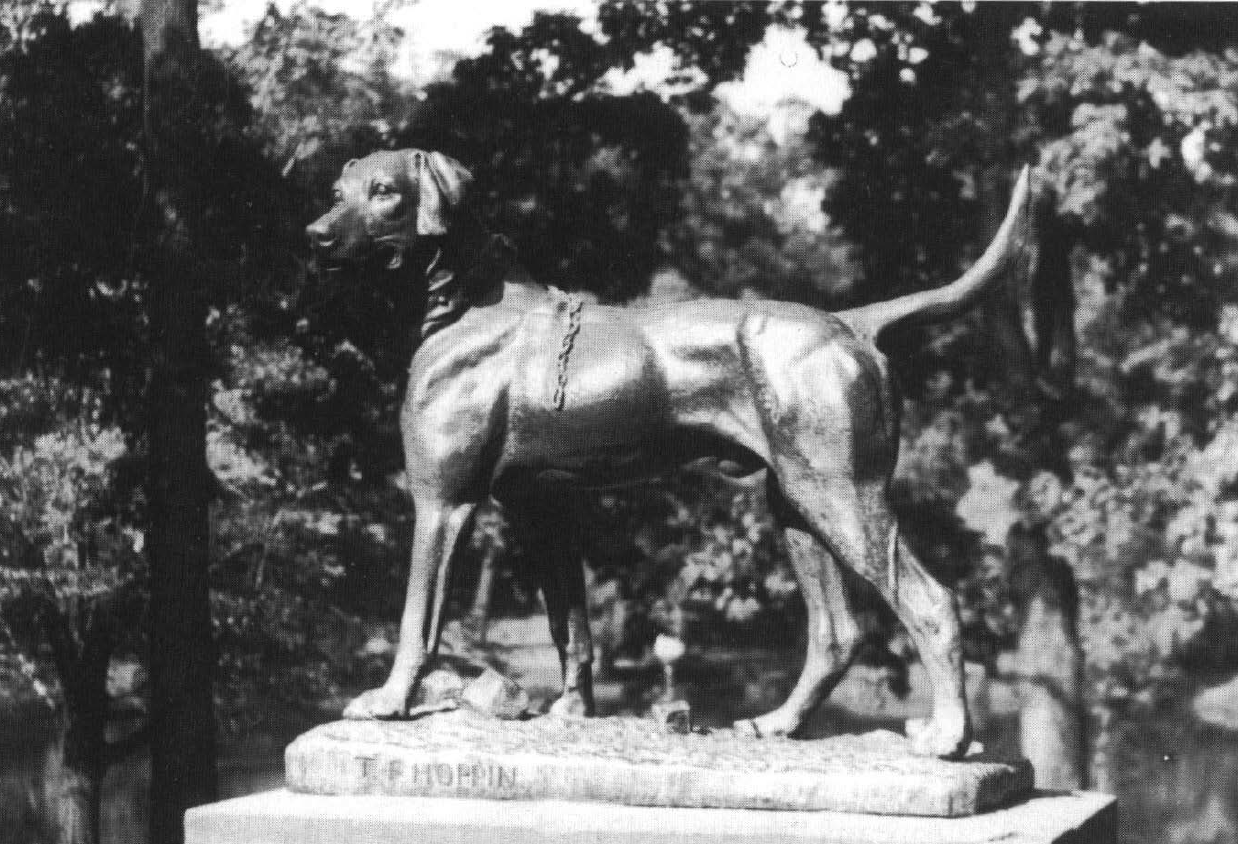
Sculptor Hoppin not only produced the sculpture of Frankiln, but also of “The Sentinel” a large dog in bronze completed in 1851 and now on display at Roger Williams Park.
Rhode Island may not have many statues of women, but scallops, bears, and one of the Rhode Island Red chicken can be found in Little Compton.
There are bulls guarding Colt State Park. A Brown Bear adorns the entrance to the University's athletic complex on Hope Street in Providence.
Statue and sculptures include an eagle at Veterans Monument in Pawtucket, a falconer at Roger Williams Park, a heron in Pawtucket, the "Elk's Rest" at North Burial Ground in Providence.
.JPG)
Casimir Pulaski is a Revolutionary War Hero. In Rhode Island, The is a state 100-acre recreational area named after the General. There are statues, but he may have not been a man.
"He is called the 'father of the American cavalry,' a Polish-born Revolutionary War hero who fought for American independence under George Washington and whose legend inspired the dedication of parades, schools, roads and bridges. But for more than 200 years, a mystery persisted about his final resting place. Historical accounts suggested the cavalryman, Casimir Pulaski, had been buried at sea, but others maintained he was buried in an unmarked grave in Savannah, Ga.
Researchers believe they have found the answer — after coming to another significant discovery: The famed general was most likely intersex," writes the New York Times.
.JPG)
The statues that portray women such as Bajnotti Fountain unveiled in 1899 and designed by Enid Yandell included imagery of a woman -- “The Struggle of Life, shows a winged angel wrestling to break through a group of male figures."
Similarly, the female image of justice outside the Federal Court House in Providence is titled "America and Providence." It was completed in 1908 and was created by John Massey Rhind. "Providence and America are massive carved marble groups which flank the entrance to the Federal Building. The allegorical female figures are arranged in pyramidal compositions against the neoclassical Beaux-Arts building designed by Clark and Howe," wrote the Rhode Island Historical Preservation & Heritage Commission.
There is a statue honoring Aphrodite and there is a "Winged Female Nude." Both pieces located in Newport.
In Providence, there is a standing bronze figure on Blackstone Boulevard of a young woman, "dressed in classical robes, seen in mid-stride, her long hair and clothing moving in a breeze. Corbett, the sculptor, was one of a number of women artists working in New York in the 1920s and 30s. Her sculpture was commissioned by Mr. and Mrs. A. Foster Hunt as a memorial to Mrs. Hunt's daughter, Constance Witherby, who died young," according to Rhode Island Historical Preservation & Heritage Commission.
"The childwoman depicted is both hesitant and confident. Sometimes taken to be a portrait of Constance Witherby, the statue is in fact a representation of the moment between youth and maturity."
.JPG)
While there are no Black Rhode Islanders memorialized, there are statues and sculptures to leaders of the Narragansett Tribe. A statue to Canonicus, Chief of the Narragansett, can be found in Jamestown. And one to Canonchet, the Narragansett leader the King Phillip's War is located in Narragansett.
A statue Saint Domenic de Guzman can be found on the campus of Providence College. And, at Roger Williams Park resides a bust of Juan Pablo Duarte, the Dominican nationalist and military leader who died in 1876.

A standing life-size Union soldier, the figure wears an infantry uniform and carries a rifle in his right hand. This is a cast of a soldier produced several years earlier by Kohlhagen for Gorham, the first large-scale bronze cast by the company.
.JPG)
Roger Willams Park, Providence, 1954, Gilbert Franklin
"A life-size standing bronze, Lincoln is portrayed in his maturity, his face impassive, the high cheekbones, large hands, and long neck, the figure in mid-step, arms at his side. Gilbert Franklin, the sculptor, was a Providence resident and a member of the faculty at the Rhode Island School of Design. The statue was created with a trust left by Henry W. Harvey, a jewelry manufacturer," Rhode Island Historical Preservation & Heritage Commission.
.JPG)
"A life-size standing bronze, Church stands easily, his arms raised to hold his cornet. He is dressed in his band uniform. Bowen R. Church played with the Reeves American Band in the early decades of the twentieth century. Their park concerts were a favorite activity for Providence residents," Rhode Island Historical Preservation & Heritage Commission.
According to his entry in the RI Hall of Fame: Church. Born in the Cumberland village of Valley Falls in 1860, Church was a musical child prodigy by the age of nine when his family took up residence in East Greenwich. Encountering young Church on a train, and then listening to an impromptu audition, Reeves became Church's mentor and eventually made him the headliner of the band.