Rich in RI - Wild Fluctuations
Stephen Beale, GoLocalProv News Editor
Rich in RI - Wild Fluctuations

Over the two most recent tax years available, the ranks of the highest earners in Rhode Island has thinned out, dropping by nearly third, the data shows.
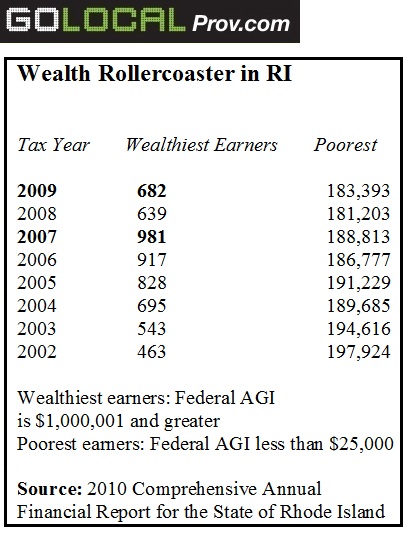
GET THE LATEST BREAKING NEWS HERE -- SIGN UP FOR GOLOCAL FREE DAILY EBLASTAt the start of the decade, there were just 463 state income taxpayers who made $1,000,001 or more in Rhode Island, according to data collected in the 2010 annual financial report for the state. Over the next few years that number continued to climb, reaching a peak of 981 individuals or joint filers in 2007. (See below chart.)
“You go from 2002 to 2007—that was the boom economy that you had,” said Joe Paolino, a former Providence mayor and a real estate business owner.
‘The economy stopped dead’
But then, in 2008, the highest-earning Rhode Islanders plummeted to 639 income tax filers, a drop of more than a third. “What happens in 2008?” Paolino continued. “The economy stopped. The economy stopped dead.”
Another report puts the total amount of wealth lost even higher—at $10.2 trillion, which is the sum of $3.3 trillion in housing equity and the $6.9 million in the stock market.
“That was the time that everything came unglued,” said University of Rhode Island economist Leonard Lardaro.
The lost wealth, he said, was not unique to Rhode Island. But the question the Ocean State now faces is whether it will be able to recover that wealth, Lardaro added. So far, the number of the wealthiest earners has edged up slightly—from 639 in tax year 2008 to 682 in 2009, the state data shows.
Millionaires bailing out of RI
But the tanking economy in 2008 is only half the story. Business owners and other experts say other factors specific to Rhode Island—such as taxes and regulation—drove many of the wealthy to move elsewhere, taking their millions with them.

Another major worry: “The estate tax is so huge that it potentially could decimate a good company or a really good asset … so people like me are saying, ‘Wow, I have 500 employees it could really ruin my company,'” White said.
A study released earlier this year shows that the estate tax—also known as the death tax—has taken a substantial toll on the amount of wealth in the Ocean State. The study indicates that between 1995 and 1997 the state lost a total of $4.6 billion in wealth due to out-migration. A key factor was the fact that other states, like Florida, do not have the death tax.
White, for one, is committed to staying in Rhode Island and fighting for lower taxes. And he still is waiting to see what happens this fall when the General Assembly holds a special session on pension reform. But he can wait only so long. “There will come a point where I say either it’s working or it’s not working,” he added. “Why would I sit here and wait for the next whack?”
Tax expert: RI needs ‘catastrophic change’
He recalled the case of one corporate executive who moved here from the Midwest. The executive continued to work at a Midwest location and commuted back on weekends to spend time with his family. Monacelli said the executive’s wife had wanted to move back because she was from Rhode Island. He said the quality of life in the state was an additional draw for the couple.
When tax time came around, the client paid taxes in the state where he worked at a rate of 3.4 percent. After that, he still had to pay an additional 2.6 percent of his income in Rhode Island—the applicable state tax rate was approximately 6 percent, but he was credited for what he paid out of state. But the cost of paying the additional taxes was too much too bear and the executive decided to move back to the Midwest after living in Rhode Island for just one year, Monacelli said.
“That was so dramatic, I was totally blown away,” Monacelli said.
And this was after the state had already dropped the highest tax bracket from 9.9 percent in 2010 to 6 percent starting this year. That’s an improvement. But, “It’s still not enough to compete with most states,” Monacelli said.

He offered a few modest proposals. One idea: be more creative about outsourcing services to private companies, such as management of the state prisons. Monacelli also backs consolidating city services and school districts—pointing to Central Falls as an extreme case of the alternative. “Central Falls … is the perfect example of what may happen to other communities because you can’t support that kind of overhead with limited revenues,” Monacelli said.
Do millionaires matter?
It’s worth asking: Should the average Rhode Islander care about fluctuations in the number of millionaires?
If you care about jobs, then yes, Monacelli said. “They’re the people who drive jobs and we need jobs,” he said. “They’re extremely important overall because that’s where you have the capital for investment.”

Rich on the rebound?
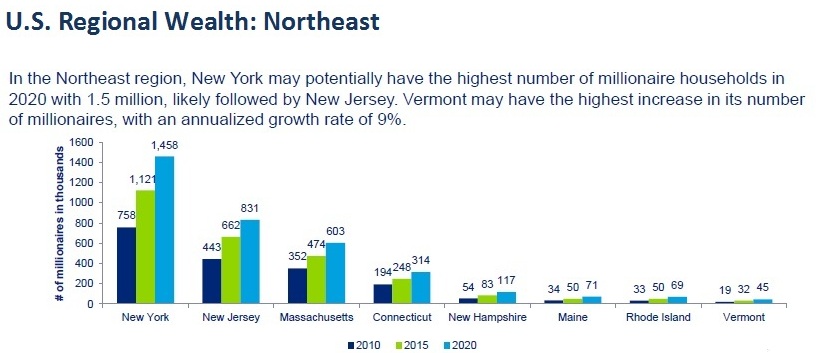
Although the wealthy have been on the decline, a recent study says the number will increase over the next five years. The study, conducted by the Deloitte Center for Financial Services, claims that between 2010 and 2015, the number of millionaires in Rhode Island will grow by 9 percent—tied with Vermont for the highest rate in the Northeast.
The study counted the wealth differently than the tax data. While the tax data measures millionaires by annual income, the Deloitte study looks at assets, which casts a wider net. The Deloitte study predicts that the wealthy will grow from 33,000 millionaires in 2010 to 69,000 in 2015. That forecast is based on the increase in investment portfolios. (See below chart.)
The study met with local skepticism. “I just don’t see it,” Monacelli said.

And, even if the study’s predictions come true, some say the benefit will be short-lived. White said if more Rhode Islanders move into the millionaire ranks, they will also move out of the state for the same reason that others have. “Put that in context, these people are then going to bail,” he said.
The view from the bottom
The mobility of the millionaires stands in marked contrast to the bottom earners. Between 2002 and 2009, the numbers of those earning $25,000 or less a year declined—but by a much smaller percentage that the wealthy. Over the course of those years, Rhode Island lost about 16,000 low-income residents. But that represents a drop-off of just 8 percent.
Lardaro said the disparity could stem from the fact that the wealthy have greater mobility.
Most people in that top bracket, White added, already own a second home somewhere else, which makes it that much easier for them to make the move.
If you valued this article, please LIKE GoLocalProv.com on Facebook by clicking HERE.