


UPDATED: Toxic Fluorinated Compounds Found in 12 RI Drinking Water Sites -- 50,000+ Impacted
GoLocalProv News Team
UPDATED: Toxic Fluorinated Compounds Found in 12 RI Drinking Water Sites -- 50,000+ Impacted

The Rhode Island Department of Health, however, is challenging the accuracy of the methodology.
The known extent of contamination of American communities with PFAS "continues to grow at an alarming rate, with no end in sight," said Environmental Working Group (EWG) in their release of the data this week.
GET THE LATEST BREAKING NEWS HERE -- SIGN UP FOR GOLOCAL FREE DAILY EBLASTAs of March 2019, at least 610 locations in 43 states are known to be contaminated, including drinking water systems serving an estimated 19 million people, according to EWG.
EWG is now proposing drinking water and cleanup standards for all PFAS chemicals as a group at 1 part per trillion (ppt). Presently, the U.S. Environmental Protection Agency's action level is 70 ppt.
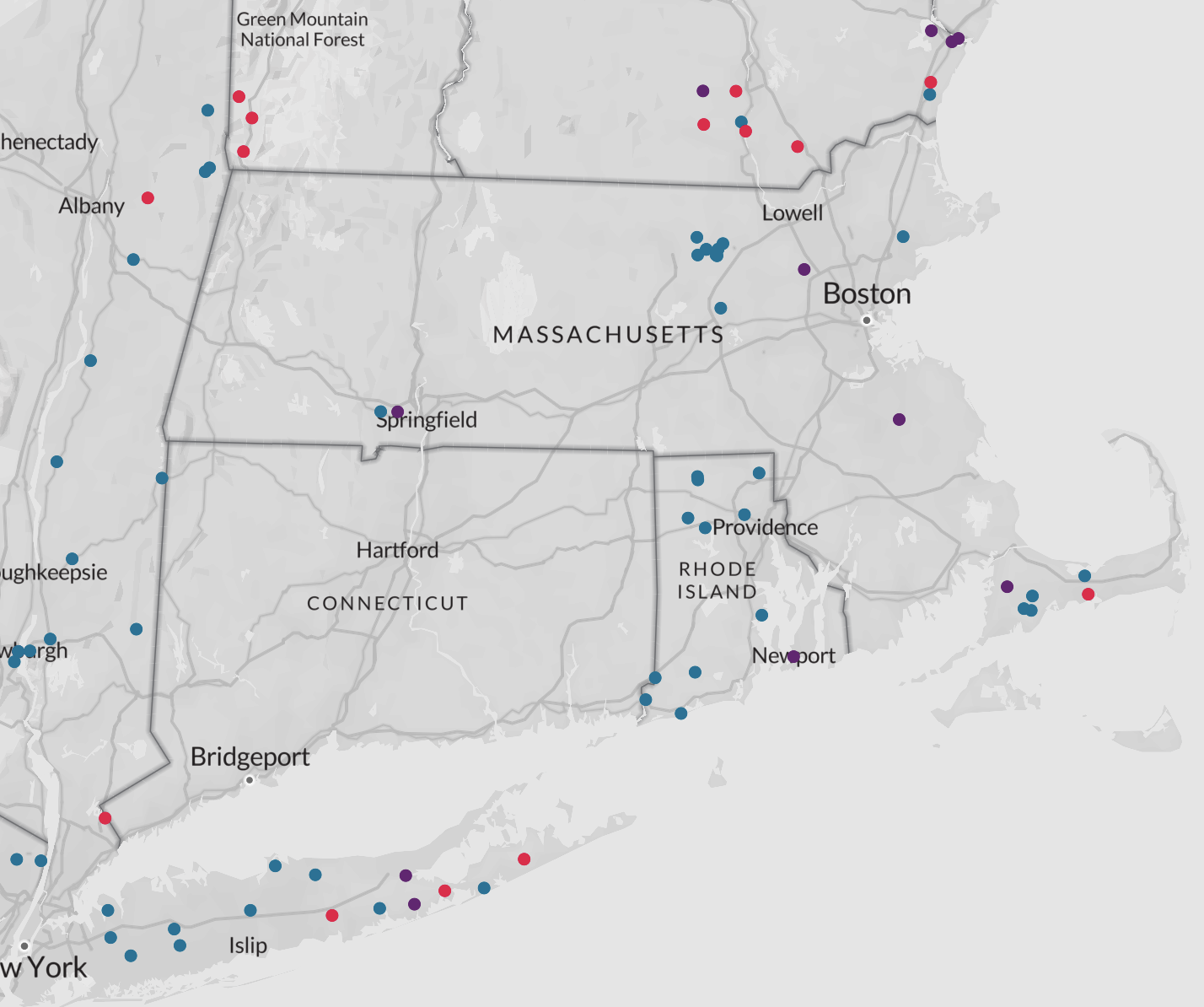
In Rhode Island, the 12 locations identified by EWG impacts more than 50,000 and includes schools systems and two entire communities water systems.
SLIDES: SEE WATER SYSTEMS TESTING WITH PFAS BELOW
RI Department of Health Takes Issue With Data
"The Environmental Working Group’s map is not accurate. The Environmental Working Group appears to have summed all PFAS results from all wells in water systems. That is not how concentrations in drinking water works," said Joseph Wendelken with the Department of Health.
Wendelken says that when the state sampled at these sites and dozens of others in 2017, one water system exceeded the EPA’s health advisory level. This water system – Oakland Association, located in a section of Burrillville – is in the process of connecting to a municipal water system.
The Rhode Island Department of Health and researchers from Brown University are now sampling at approximately 50 more water systems throughout the state to collect data on a group of chemicals called per- and polyfluoroalkyl substances (PFAS). This sampling is a follow-up to previous rounds of sampling. Between 2013 and 2015, all public water systems in Rhode Island serving more than 10,000 people were tested for PFAS. In 2017, RIDOH and Brown sampled 41 smaller public water systems and licensed child care facilities near potential sources of PFAS. (These additional 50 systems are being tested because new information is available about potential sources of PFAS.)
"Sampling for PFAS is one of the many forms of rigorous, frequent testing that is done on Rhode Island's water supply," said Director of Health Nicole Alexander-Scott, MD, MPH. "The water sampling initiative we are doing now will help us identify any sources of PFAS in Rhode Island and partner with water systems to ensure that customers are notified and treatment plans are put in place right away."
One of the sites identified by EWG that tested positive for PFAS was Yacht Club Soda Company. The company tells GoLocal that they now no longer use that water source.
"That source is no longer in service. We took it offline because of the increased cost of testing and maintenance," said John Sgambato with Yacht Club. "My filtration eliminates them from the product water but increased testing cost and regulation made us take it offline."
“Providence Water has tested for 6 per- and polyfluoroalkyl substances and to date has not detected any of these substances in our water,” said Providence Water in a statement to GoLocal on Wednesday.
EWG Responds to RI Department of Health
In response to comments by the RI Department of Health regarding the interpretation of data, Bill Walker, Vice President of EWG said in a statement to GoLocal, "EWG’s data on contaminated water systems comes from two sources: (1) An EPA database for results from the Unregulated Contamination Monitoring Rule program, which from 2013 to 2015 required most public water systems to test for PFAS chemicals, and (2) data obtained from the Rhode Island Department of Health’s Drinking Water Quality site in April 2018. The individual pop-up boxes for each map point do list the range of the total of all PFAS detected at the time indicated."
Walker said, "However, the map (data) is not meant to show the level of contamination of water delivered to homes, but what was detected in each system at the time of the test. It is a map of the known extent of contamination, not whether or not that level has been mitigated. A system that is treating its water to remove PFAS to regulatory levels – and there are varying positions among the EPA, states and research scientists on the safety of those levels– is still a contaminated system, and indicative of the scope of the problem, because the water system and its customers are paying for the treatment.
EWG's Data & Dept. of Health's Warnings
EWG and the Social Science Environmental Health Research Institute, at Northeastern University tracks publicly known pollution from PFAS chemicals nationwide, including public water systems, military bases, military and civilian airports, industrial plants, dumps and firefighter training sites. According to EWG, the map is the most comprehensive resource available to track PFAS pollution in the U.S.
“The updated map shows that PFAS contamination is truly a nationwide problem, impacting millions of Americans in hundreds of communities,” said Phil Brown, a professor of sociology and health sciences at Northeastern University and director of the Social Science Environmental Health Research Institute. “Leaders in many communities and states are doing great work to raise awareness about PFAS and push for cleanup, but this is a national crisis demanding national action. The EPA should act more quickly to evaluate all PFAS chemicals and restrict their use, and polluting industries should be held responsible.”
According to the RI Department of Health, “If people ingest PFAS (by eating or drinking food or water that contain PFAS), the PFAS are absorbed, and can accumulate in the body. PFAS can be found in blood, and at much lower levels in urine, breast milk and in umbilical cord blood. PFAS stay in the human body for long periods of time. As a result, as people get exposed to PFAS from different sources over time, the level of PFAS in their bodies may lead to adverse health effects. The likelihood of adverse health effects depends on several factors such as the amount and concentration of PFAS ingested as well as the time span of exposure.”
The Department of Health on their website writes the following under the heading, "What steps should I take if concerning levels of PFAS have been detected in my drinking water?"
The Rhode Island Department of Health recommends taking the following steps to minimize risk:
DO NOT boil your water. Boiling water will concentrate these chemicals.
Reduce your risk of exposure to these chemicals by using bottled water or other licensed drinking water that has been tested for these chemicals or that uses a treatment that removes these chemicals (specifically activated carbon or reverse osmosis). Many major bottled water brands use this treatment.
Water from a safe source should be used for drinking, food preparation, cooking, brushing teeth, and any activity that might result in swallowing water.
Parents of formula-fed infants may consider using a formula that does not require adding water.
This story was first published 5/8/19 12:25 PM and was updated 5/9/19 at 6:10 AM.
PFAS Contamination -- May 8, 2019

System name: Charlestown Elementary School
State: Rhode Island
Population served: 350
Testing dates: 09/08/17 - 09/08/17
PFAS detected: PFOA, PFOS, PFPeA
PFAS min - max: 33.6 - 33.6 ppt
Source: EWG from drinking water test data

System name: Trinity Lutheran Preschool
State: Rhode Island
Population served: 45
Testing dates: 09/28/17 - 09/28/17
PFAS detected: PFOS
PFAS min - max: 4.04 - 4.04 ppt
Source: EWG from drinking water test data

System name: Westerly Water Department
State: Rhode Island
Population served: 38,000
Testing dates: 09/16/15 - 10/03/16
PFAS detected: PFOA, PFOS
PFAS min - max: 0 - 74.2 ppt
Source: EWG from drinking water test data

System name: Quonochontaug East Beach Water Association
State: Rhode Island
Population served: 200
Testing dates: 09/22/17 - 09/22/17
PFAS detected: PFBS, PFHxA, PFOA, PFOS, PFPeA
PFAS min - max: 47.93 - 47.93 ppt
Source: EWG from drinking water test data

Contamination site: Naval Station Newport
Location: Newport County, Rhode Island
Date of discovery: 2018
Results (PFOS/ PFOA) or Range above EPA LHAs:(on-base) Combined PFOS/PFOA = 95-20,420 ppt
Other Results PFAS or Range above EPA LHAs:N/A
Suspected source: Firefighting foam used at Naval Station Newport
Source: EWG from Department of Defense

System name: Ladd Center Water System
State: Rhode Island
Population served: 129
Testing dates: 09/08/17 - 09/08/17
PFAS detected: PFBS, PFHpA, PFHxA, PFOA, PFOS, PFPeA
PFAS min - max: 80.86 - 80.86 ppt
Source: EWG from drinking water test data
System name: Scituate High School and Middle School
State: Rhode Island
Population served: 1,400
Testing dates: 09/21/17 - 09/21/17
PFAS detected: PFHpA, PFHxA, PFOA, PFOS, PFPeA
PFAS min - max: 48.18 - 48.18 ppt
Source: EWG from drinking water test data
System name: Yacht Club Bottling Company (No longer in service)
State: Rhode Island
Population served: 0
Testing dates: 10/12/17 - 10/12/17
PFAS detected: PFBS, PFHxA, PFHxS, PFOA, PFOS, PFPeA
PFAS min - max: 128.46 - 128.46 ppt
Source: EWG from drinking water test data
System name: The Village On Chopmist Hill
State: Rhode Island
Population served: 250
Testing dates: 08/25/17 - 08/25/17
PFAS detected: PFOA, PFOS
PFAS min - max: 16.91 - 16.91 ppt
Source: EWG from drinking water test data
System name: Ohm Ganesh DBA Country Farms
State: Rhode Island
Population served: 33
Testing dates: 10/02/17 - 10/02/17
PFAS detected: PFNA
PFAS min - max: 4.1 - 4.1 ppt
Source: EWG from drinking water test data

System name: Oakland Association Inc.
State: Rhode Island
Population served: 175
Testing dates: 08/24/17 - 09/26/17
PFAS detected: PFBS, PFHpA, PFHxA, PFHxS, PFOA, PFOS, PFPeA
PFAS min - max: 147.82 - 205.12 ppt
Source: EWG from drinking water test data

System name: Cumberland
State: Rhode Island
Population served: 22,864
Testing dates: 02/18/15 - 05/27/16
PFAS detected: PFOA, PFOS
PFAS min - max: 0 - 81 ppt
Source: EWG from drinking water test data


