


The 20 Largest Campaign Donors in Rhode Island
Dan McGowan, GoLocalProv News Editor
The 20 Largest Campaign Donors in Rhode Island
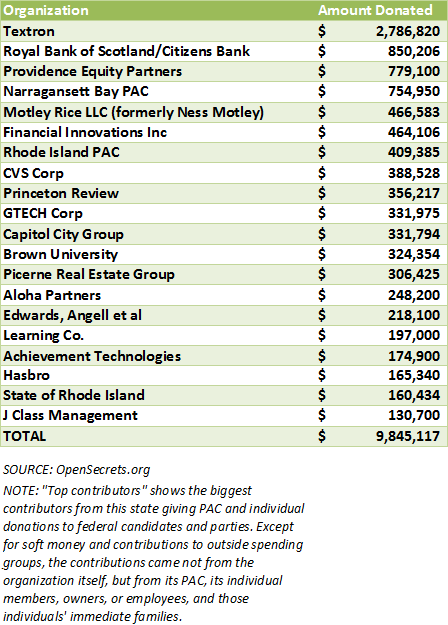
Rhode Island’s top 20 federal campaign donors have spent close to $10 million over the last decade contributing to candidates nationwide, with the bulk of the money being spent by Political Action Committees (PAC) run by some of the largest companies in the state, according to figures found on OpenSecrets.org.

GoLocalProv tallied contributions made over the last five election cycles and found that Textron (one of only two Fortune 500 companies in the state) has spent at least $2,786,820 through its PAC over the past ten years, nearly $2 million more than any other company.
The campaign funds do not come directly from the organizations listed, but “from its PAC, its individual members, owners, or employees, and those individuals' immediate families,” according to the Center for Responsive Politics, which operates OpenSecrets.
GET THE LATEST BREAKING NEWS HERE -- SIGN UP FOR GOLOCAL FREE DAILY EBLASTIn addition to Textron, the top five contributors have been the Royal Bank of Scotland/Citizens Bank ($850,206), Providence Equity Partners ($779,100), Narragansett Bay PAC ($754,950) and Motley Rice LLC ($466,583). The Narragansett Bay PAC is run by Senator Jack Reed.
Spreading the Wealth to Other States
With election season already beginning to take form –Textron’s PAC had already spent $164,000 as of June 30 – the influence of corporate money will continue to play a larger role, according to Rhode Island College Political Science Professor Kay Israel.
But because Rhode Island has such a small Congressional Delegation (two Senators and two Congressman), the majority of money from the state’s top contributors goes to candidates in other parts of the country. Textron, for example, has donated $7,000 to Senator Sheldon Whitehouse and Congressman James Langevin during the 2012 cycle, but it has spread the wealth across the country to dozens of elected officials, including House Budget Committee chairman Paul Ryan, Massachusetts Senator Scott Brown and South Carolina Senator Jim DeMint.
“Company PACs and wealthy donors from RI can have even more influence by going beyond just our two Senators and two Congressmen by spreading their wealth to candidates from other states---especially those in key leadership roles and those on the committees who oversee their industries,” Israel said.
Israel said it’s not just contributions directly to campaigns some of the top spenders make either. He said corporations like Textron, Cox Communications or GTECH are free to spend whatever they would voice their concerns on issues and potential legislation.
“If one looks at a publication such DC's The Hill, page after page of ads address issues dealing with one industry or cause after another,” Israel said. “It has become annual rite for many share holders to vote on whether their companies should be force to disclose their expenditures.”
Common Cause: An Enormous Industry
And corporate spending isn’t going away. Common Cause Executive Director John Marion said attempts to influence Congress through lobbying and campaign donations has “become an enormous industry.”
Marion said the same isn’t necessarily the case in Rhode Island, where elections tend to be less expensive. He said big businesses in the Ocean State tend to focus on lobbying as opposed to contributing directly to campaigns.
“I believe there a couple of factors there; one is our fairly uncompetitive and inexpensive elections,” Marion said. “Another is the lack of an initiative process here, which typically draws a lot of money into elections in other states. That doesn't mean they aren't trying to influence the policy process, they're just pursuing different paths than elsewhere.”
Quest Research pollster Victor Profughi agreed with Marion. He said that because the power on Smith Hill is almost entirely held by General Assembly leadership, there is less of a premium on election financing than on courting the few who matter the most.
“A couple of things grow out of this: first the biggest funding source for most legislative candidates is the candidate himself/herself via self-financing; second, the legislative leaders help the process along with their own PACs,” he said. “While some big Rhode Island employers like Textron, lawyers/lobbyists, and the banking/financial interests are major donors, they are most effective through their use of seasoned lobbyists.”
Liberal Activist: Eliminate Influence of Money
It doesn’t matter where the money goes, according to Progressive activist Rhode Island’s Future blog editor Brian Hull, who said he is troubled by the role corporations play in politics. He said he doesn’t like that corporations are treated as individuals, “especially considering the likelihood that corporate campaign contributions could go to support a candidate that the vast majority of workers of the corporation don't actually support.”
Hull said the Supreme Court ruling in Citizens United – which gave corporations and unions the right spend as much as they want on elections- “is the worst infestation of unaccountable manipulation of the political process. He said it’s time for money to be taken out of the political process.
“What the country needs is a process which eliminates the corrupting influence of money and wealth in the political process so that voters don't have to be concerned with the appearance of special interest vote buying, whether real or imagined,” Hull said.
Public Financing
Marion said Common Cause also supports public financing. He cited disgraced lobbyist Jack Abramoff recent memoir, which described the flawed system the influence of money has created in the country.
“Rhode Island has some industries, health care and defense in particular, whose bottom line is heavily influenced by federal policy and Rhode Island companies fully participate in that flawed system. Common Cause believes the Fair Elections Now Act, which creates a system of voluntary public financing for Congressional elections, is fundamental to changing the dynamics of that system,” Marion said.
If you valued this article, please LIKE GoLocalProv.com on Facebook by clicking HERE.