

| | Advanced Search


Rhode Island’s Best Communities 2013: #39 to #21—The 4th annual analysis of RI's 39 cities…

NEW: RI Pharmacist Leo Blais Loses License Permanently—You won't believe what happens out there...

Rob Horowitz: The Ultimate City: Bohemians, Gays & Jobs—Location, location, location...

Little Compton #21: RI’s Best Communities 2013—Cast your vote! and variations...

West Greenwich #22: RI’s Best Communities 2013—Cast your vote! and variations...

Westerly #23: RI’s Best Communities 2013—Cast your vote! and variations...

North Smithfield #24: RI’s Best Communities 2013—Cast your vote! and variations...

NEW: Salvatore Wants Review of Disabled Abuses at Birch Vocational—Civil rights violations...

Glocester #25: RI’s Best Communities 2013—Cast your vote! and variations...

Cumberland #26: RI’s Best Communities 2013—Cast your vote! and variations...


slides: RI + New England’s Crumbling Infrastructure Costs Drivers Billions

Wednesday, March 20, 2013


The country's infrastructure is woefully in need of repair and reinvestment, earning an overall grade of D+ on the 2013 Report Card for America’s Infrastructure from the American Society of Civil Engineers (ASCE), and New England is no exception.
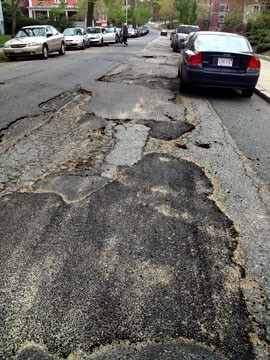
The report card, which looks at infrastructure across 16 different sectors including bridges, dams, roads and railways in its cumulative GPA, is issued every four years. The U.S. saw a slight increase in its grade this time around from a D in 2009 to the current D+, but experts say there's still more to do, with ASCE estimates for total investment needs at $3.6 trillion by 2020 across all 16 sectors.

“A D+ is simply unacceptable for anyone serious about strengthening our nation’s economy; however, the 2013 Report Card shows that this problem can be solved. If we want to create jobs, increase trade, and assure the safety of our children, then infrastructure investment is the answer,” said ASCE President Gregory E. DiLoreto.

The highest grade on the 2013 report card was a B- for solid waste infrastructure, while the lowest grades were D- for inland waterways and levees. However, none of the categories received a lower grade than in 2009.

“We must commit today to investing in modern, efficient infrastructure systems to position the U.S. for economic prosperity," said DiLoreto. "Infrastructure can either be the engine for long-term economic growth and employment, or, it can jeopardize our nation’s standing if poor roads, deficient bridges, and failing waterways continue to hurt our economy.”

Check out the details of the current state of infrastructure around New England, and see how much your state's roads, bridges and dams are costing you each year as a motorist.

Prev Next

Rhode Island

$467 per motorist per year

The Ocean State needs $428 million to maintain and upgrade its drinking water systems over the next two decades. Wastewater numbers were not reported.

Rhode Island currently has 87 high hazard dams and 156 structurally deficient bridges.

Nearly three quarters, or 70 percent, of the state's roads are poor or mediocre quality, costing motorists $467 per year.

Prev Next

Massachusetts

$313 per motorist per year

In order to maintain and upgrade systems in the Bay State over the next 20 years, $6.8 billion will be required for drinking water and $8 billion will be needed for wastewater.

The Commonwealth is home to 341 high hazard dams and 493 structurally deficient bridges. 

In terms of roadways, 42 percent of the state's roads are poor or mediocre quality, costing motorists $313 per year.

Prev Next

Connecticut

$294 per motorist per year

Connecticut will need $1.4 billion for drinking water systems and $3.6 billion for wastewater systems in order to maintain and upgrade them over the next 20 years.

The state is also home to 233 high hazard dams and 406 structurally deficient bridges.

A whopping 73 percent of Connecticut's roads are of poor or mediocre quality, costing drivers $294 per year.

Prev Next

New Hampshire

$259 per motorist per year

When it comes to maintenance and upgrades over the next 20 years, the Granite State is facing $847 million for drinking water systems and $1.2 billion for wastewater systems.

New Hampshire has 106 high hazard dams and 362 structurally deficient bridges.

Just over half, or 54 percent, of the state's roads are poor or mediocre quality, working out to an annual cost of $259 for New Hampshire motorists.

Prev Next

Vermont

$424 per motorist per year

The Green Mountain State needs $453 million for drinking water and $218 million for wastewater in order to keep its systems upgraded and maintained over the next 20 years.

Fifty six dams in Vermont are designated as high hazard, and 288 of the state's bridges are structurally deficient.

While only 45 percent of the state's roads are of poor or mediocre quality, they're still costing drivers $424 each year.

Prev Next

Maine

$245 per motorist per year

The Pine Tree state is facing $540 million in upgrades and maintenance for its drinking water systems over the next 20 years and $1 billion for its wastewater systems.

Maine has 77 high hazard dams and 356 structurally deficient bridges.

Just over half, or 53 percent, of Maine's roads are poor or mediocre quality, working out to $245 a year in costs for the state's motorists.


Related Articles


Enjoy this post? Share it with others.


Commenting is not available in this channel entry.