


Rhode Island's Top High School: East Greenwich High School
Tracey Minkin and David Hanyok, GoLocalProv Correspondent
Rhode Island's Top High School: East Greenwich High School
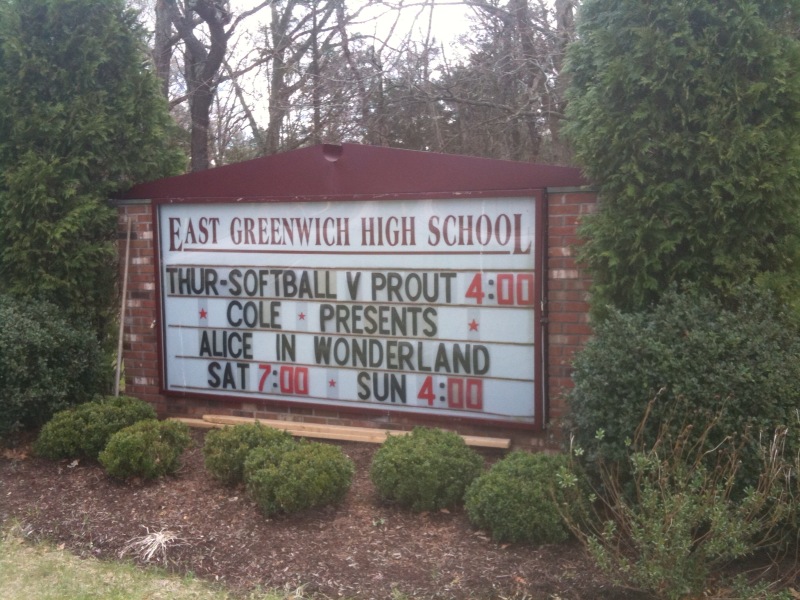
East Greenwich consistently produces phenomenal results on NECAP tests and the SATs, both gold-standard markers of accomplishment. But it was a better student-teacher ratio and larger per-student budget that gave the final push to this school of an enrollment that hovers around 750 students.
"East Greenwich High School was a perfect size," says Giulia Basile, an EGHS alum and student at Brown University. "Not too big, not too small." Basile adds that her teachers managed to maintain great relationships with students while simultaneously pushing them to succeed. "I was challenged," she says, "but I never felt like I was part of a hyper-competitive environment. The students and the teachers worked hard but still could be relaxed and have fun."
"The school has a lot of high-achieving students which tends to drive the overall gestalt of the place," says Elizabeth McNamara, mother of an EGHS grad and a current student. "My children have had some very good teachers and have benefitted from the school's relatively small size. It combines the best of public and private in that way."
GET THE LATEST BREAKING NEWS HERE -- SIGN UP FOR GOLOCAL FREE DAILY EBLASTBeyond the numbers are parents and kids who have often come to East Greenwich for the schools, and have stayed, prospered, and supported those institutions. Elizabeth and John (Jay) Gowell did just this 17 years ago with their then-infant and toddler children, and look back on a high school that propelled their eldest, interested in language and arts, to Georgetown University, and her younger brother, a math-oriented boy who graduates this year from EGHS, also to Georgetown this fall (their third enters EGHS next year).
"My kids have had terrific experiences," says Elizabeth Gowell, who points out that not only were her children supported in academic ways that lead to high scores such as the ones in our rankings, but that gave her kids opportunities to expand their horizons. "My daughter was connected through her Spanish teacher to an Arabic tutor in the community," she says. "And I think that having some strong art teachers within the school, having a curriculum that allowed her to balance that art with academics, was really important," she says.
Gowell's son was able, with the commitment of the school, to study Latin for four years at EGHS. An aspiring science student, he also enjoyed the fruits of a recent push in East Greenwich to upgrade facilities district-wide: in this case, a renovated science lab that was funded through a $52-million town bond approved by East Greenwich voters in November, 2008.
"The voters overwhelmingly approved it," says Elizabeth's husband Jay, who serves as Chairman of the East Greenwich Public Schools Building Committee. "That's a thing we're really proud of in a difficult economic time," he says.
Next on the list at EGHS, funded by the bond: a facelift to the entrance to the school, which, says Elizabeth, will present an exterior more in keeping with the excellence contained within. With a ranking like number one, that's just bonus.
Watch East Greenwich kids react to the news, here.