Over 50% of Dropouts Come From Just 12 RI Schools
Wednesday, May 30, 2012
Yajaira Cortes was only 16 when she became another statistic at what she refers to as Mount Pregnant High School.
That was ten years ago. Then a junior at Mount Pleasant, she recalls receiving little support at home and even less at school once it was clear she had a child on the way. With the world giving up on her, she gave in. School became an afterthought.
“I was really discouraged,” she said. “I didn’t know about any of my options.”

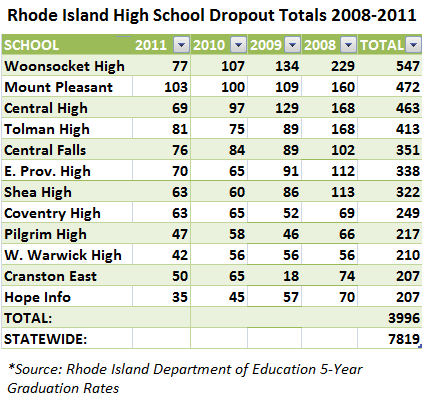
In the last four years alone, just over 7,800 students have dropped out of school in Rhode Island. Of that number, over 50 percent (3,996) come from just 12 high schools, according to a GoLocalProv analysis of 5-year cohort dropout rates between the class of 2008 and the class of 2011. Depending on the year Rhode Island had between 58 and 62 public high schools.
The schools that produce the most dropouts come as little surprise. Mostly urban. Mostly overcrowded. 547 dropouts came from Woonsocket, another 472 from Mount Pleasant. 351 came from Central Falls. Pawtucket’s struggling high schools (Tolman and Shea) have produced a combined 722 dropouts. The larger schools, such as East Providence, Coventry and Cranston East also make the list.
Unacceptable Numbers
Rhode Island’s struggles are part of a nationwide epidemic that has one in four students not completing high school on time, according to researchers at the Everyone Graduates Center at Johns Hopkins University. As of 2009, the dropout rate among minority students was 40 percent.
For Dr. Robert Balfanz, the co-director of the Everyone Graduates Center, the numbers are simply unacceptable.
“[We] need to design the school to meet the educational challenge it faces, so if it knows most students are coming in behind grade level and with poor attendance in middle school, it needs supports from day one to help kids get to school and to close their knowledge and skill gaps,” Balfanz told GoLocalProv in an interview. “So if 100 students are reading at 5th grade level, need to make sure, you have the capacity to offer all 100 the appropriate extra supports.”
But offering that much support to struggling students and turning around dropout factories –the schools that graduate less than 60 percent of their students— can be easier said than done. With new measurers seemingly being implemented every year, educators have become increasingly skeptical of school reform efforts, particularly when outcomes are largely decided by test scores.
Balfanz said a positive culture in schools is vital.
“There is a lot a school can do to propel students to come, behave and try,” he said. “Building a strong can do culture among students and staff, and providing sufficient student supports so all students in need have someone [to look up to is important].”
More Than One Answer
According to Denise Jenkins, who oversees education grants at the Rhode Island Foundation, the key is also knowing that “there is not just one answer to the dropout question.”
Jenkins said Rhode Island has taken steps to implement a teacher evaluation system that is now being implemented across the state. At the same time, the Rhode Island Foundation recently offered a grant that helped to create United Providence, a first-of-its-kind labor-management compact between the Providence Public School District and the Providence Teachers Union that is drawing national attention.
According to Education Commissioner Deborah Gist, ensuring that schools are exciting and engaging places where students and teachers share a culture of learning and high achievement a Gist pointed to the turnaround at Central Falls High School, which improved its graduation rate by 17 percentage points in 2011, as a success story in the state.
She credited the school with doing whatever it takes to make sure students succeed, which includes offering Saturday and summer classes to help students catch up and providing over 70 hours of extra tutoring each for students at risk of falling off track.
“Overall, the schools that are improving their graduation rates and reducing the dropout rates are acting with urgency, engaging students and families, and connecting students with the services they need to rapidly accelerate their learning,” Gist said.
Gist said the state will soon begin implementing a new diploma system that requires schools to provide students who fail to demonstrate partial proficiency with intensive support to improve their performance.
“We need to ensure that our students who graduate from high school are truly prepared for success in college and in challenging careers, and we also share the responsibility of providing all students with every opportunity to earn a high-school diploma,” she said.
An Economic Incentive

The incentive to improving the graduation rate is two-fold: More high school graduates means a more educated workforce that will be able to compete in the global economy. Perhaps more directly, reducing the number of dropouts in the state and across the country will save taxpayers billions.
“Adults who do not graduate from high school are more likely to be unemployed, live in poverty, receive public assistance, be involved in criminal activity and have poor physical and emotional health than those who graduate,” said Elizabeth Burke Bryant, executive director of Rhode Island Kids Count.
According to a 2009 study published by the Education Equality Project, the expected lifetime earnings of a high school dropout is $827,438; the expected earnings of a high school graduate is $1.2 million. The expected lifetime costs to the state of a dropout, between public assistance and incarceration, is $440,214.
Yajaira has firsthand knowledge of what a dropout can cost the state. With few skills, no diploma and a child to take care of, finding a job was nearly impossible. She was forced to turn to public assistance.
“It was really hard,” she recalls. “I had temp jobs but couldn’t find much. Not have any experience always put me at the bottom of the food chain.”
Alternative Programs the Answer?
But Yajaira found an answer.
At age 24, still without even her GED, she walked through the doors at Youthbuild Providence. An alternative education and workforce-development program that helps high school dropouts gain the literacy and job-readiness, Youthbuild is among several programs in the city that are helping young people get back on track with their lives.
With the support of the Youthbuild staff, she earned a GED and is now a student at the Community College of Rhode Island. She hopes to become a social worker.
She said she wants to begin working with students who are experiencing the same problems she faced a decade ago. With thousands of Rhode Islanders still dropping out each year, Yajaira hopes to help students defy the odds.
“I like to help others,” she said. “I want them to know there’s a light at the end of the tunnel.”
Dan McGowan can be reached at dmcgowan@golocalprov.com.
Related Articles
- Chronic Absenteeism Plagues Urban High Schools
- 40 Percent Of Providence Schools Could Be Failing
- Providence Schools in Crisis: 37% of Students are ‘Chronically Absent’
Enjoy this post? Share it with others.
Commenting is not available in this channel entry.


Comments:
barnaby morse
6:37am on Wednesday, May 30, 2012
Gist calls CF a success story? Just because some students have been funneled into alternative graduation programs does not mean these students have the skills to join the workforce. At least the numbers are reduced & that's what counts.
louis rizzo
6:51am on Wednesday, May 30, 2012
you needed to investigate this? glad Hope is bringing up the rear
Charles Beckers
8:09am on Wednesday, May 30, 2012
Missing information: How many high schools are there in Rhode Island and what is the distribution of those schools by municipality? It is clear from your list that the drop-out schools are not all in one municipality, but they do appear to all be heavily urban schools. What could we conclude from the missing information?
Chris MacWilliams
8:10am on Wednesday, May 30, 2012
"...begin implementing a new diploma system that requires schools to provide students who fail to demonstrate partial proficiency with intensive support to improve their performance."
Is the new diploma system going to be called "social promotions?"
Dan McGowan
8:20am on Wednesday, May 30, 2012
Charles,
Great point. I've updated the piece to include that info. Depending on the year, there was between 58 and 62 schools. That's counting the DCYF school and all of Hope's schools separately.
Thanks so much for reading and I always appreciate the critique.
Dan
dmcgowan@golocalprov.com
Roland Lavallee
8:58am on Wednesday, May 30, 2012
Wait a minute! Why should people like Yajaira Cortes be included in the dropout rate? It has NOTHING to do with school education programs. She screwed up, literally, and got pregnant. And of course, we can all guess who paid for her and the child until she finally did something for herself.
Now, as far as teaching, this whole English language learner programs, well, my grandparents couldn't speak a lick of English when they came nor could my uncles and aunts. THEY LEARNED BY EMERSION! These ESL are a scam. Do not charge the taxpayer for something they should be learning on their own or at night with FREE courses.
Again, have you people seen, heard, or witnessed how kids talk to parents, teachers, neighbors? Would you feel compelled to go the extra mile when some kid is dropping f-bombs at you all day long and the ACLU calls it free speach?
We will never solve the education problem as long as government tries to raise your children from cradle to grave. I was not babied but I was given the desire to learn through respect of elders.
Until we realize that if you want a better educated kid, send a better raised kid to school.
Roland Lavallee
8:59am on Wednesday, May 30, 2012
and yes, I misspelled 'speech'.
Tom Hoffman
9:21am on Wednesday, May 30, 2012
The graduation rate may be up 17% at Central Falls High School, but reading proficiency for 11th graders is down 14%, writing down 15% and math is flat (at 7%).
I would LOVE to know how much of that grad rate increase is due to better tracking of leaving students. There is huge transience in CF, and whether or not someone counts as a drop out depends in part on if you can document their re-enrollment in another school. I bet they're spending a lot more time tracking down those kids.
pearl fanch
9:42am on Wednesday, May 30, 2012
Is anyone surprised at this?
Just keep lowering the graduation standards, and soon everyone will graduate.
Kinda like sweeping the problem under the rug.
David Beagle
10:04am on Wednesday, May 30, 2012
“[We] need to design the school to meet the educational challenge it faces," Not a good idea. In the real world 2+2=4 whether you're a poor minority from an urban district or a rich kid from Barrington. Lowering the bar to make the numbers look good helps no one. How about seeing if there is a relationship between teacher attendance and drop out rates.
Gary Arnold
11:05am on Wednesday, May 30, 2012
I have always been against multi-tiered schools that are adapted to the student groups vs the students as a whole.
There are just going to be kids that will not graduate due to reasons outside the control of the education system. We not only have to qualify teachers better we also have to qualify kids better. The trade schools are one way to direct those that lack the attitude or capability to progress through standard educational course work.
It is a fact that we have to come to grips with.
Stop beating your heads against a wall.
Ed Jucation
11:08am on Wednesday, May 30, 2012
It's obviously the teachers fault for Yahaira dropping out. They didn't teach her to control her libido and/or use birth control. It's also the teachers fault that she received little support from her family. The teachers should have gone right to her home after school to see if the parents needed anything to help support their daughter. She wouldn't have collected all that welfare if the teachers had done their job. Now at 24 with welfare benefits running out she finally takes responsibility for her life and gets her GED. When she gets a job, maybe she can find it in her heart to pay back the State of Rhode Island for taking care of her and her baby all these years. But the teachers didn't instill positive values on her and she won't. Those damn teachers.
Bernie McCrink
11:40am on Wednesday, May 30, 2012
Half of the dropouts coming from 12 particular schools means very little unless we know what percentage of students in the state were attending those schools. Those seem to be among the largest schools in the state so it would be expected they'd have significant dropout numbers. Thew more important statistic would be what their individual dropout rates are.
C B11
1:12pm on Wednesday, May 30, 2012
You don't need s diploma to become a State-funded baby momma. In fact, it counts againt you! Attach a job to a Welfare check (the crappier the better) and see how fast the graduation rates rise!
Bernie McCrink
1:24pm on Wednesday, May 30, 2012
The larger Providence high schools also run at a distinct disadvantage. the urban districts have a weaker student population to begin with for whatever reason you want to choose. Blame the high percentage of immigrants, the higher poverty rates, language issues, the culture of the city, whatever you want. The best students in Providence get gobbled up by the private schools and Classical and the remaining ones get distributed throughout the city. For the last half dozen years or so, the administration is suspected of sending the best of those students to Hope because Hope was in intervention. This was the reformers can take credit for "turning around" a school. The result for other schools is they get dealt a bad hand from a bad deck. How can they not be among the schools not performing well?
Joseph Fazio
8:14pm on Wednesday, May 30, 2012
So I guess you already did the research but didn't include Rhode Island law H 5061 on compulsory attendance in the State of Rhode Island. Signed into law on 7/13/11 it states that... "children who have completed 16 years of life and who have not yet attained 18 years may not withdraw from school before graduation." They don't drop out in the urban core - they just don't come, they move, they transfer, they move out-of-state. So it's a truancy issue. Go ahead and ask why we have gangs of teens roaming the streets in the middle of the day. Answer the RI ACLU fought to get rid of truancy court. So go ahead and solve the problem of MAKING kids show up and ready to learn. Wake up Rhode Island and stop buying the B.S. that edu-wonks and do-gooders are selling. Education is a privilege. The role of the student is to learn - not disrupt, sell drugs, fight, or bother others. The role of the parent is to get the kid up, off to school and make sure they do their homework. Time to go back to the way things use to be - don't like school get out, get a job, or join the military. When we stop buying the nonsense that Gist is selling we can reclaim our schools and let local taxpayers decide what is bets for their schools.
Wuggly Ump
10:57pm on Wednesday, May 30, 2012
J Fazio is so right.
Why so much pushing for graduating students? This is outcome based education, everyone into the cookie cutter, everyone must graduate. Why?
We need menials, floors need sweeping, trash needs to be taken out ditches need digging.
If the State would stop paying people for not working, and if the State would reduce taxes and regulations letting businesses grow.
The dropouts would be able to find work, make a living and convince their kids to get an education.
Another plus would be the resources used to try to keep these kids in school will be used for the kids willing to work for the grade.
There will always be dropouts.
Michael Trenn
9:16am on Thursday, May 31, 2012
God forbid we should have enough charter schools to offer alternatives to these kids before they droip out, though. We could never do that. Those teachers in the 12 High Schools are doing the best they have with what they've got, an archaic, top-down created system of sheer boredom.
Tom Hoffman
9:27am on Thursday, May 31, 2012
Yes, because people are beating down the doors to open charter high schools in Providence. Even AF wouldn't even propose to do it until sometime after 2020, right? And that was just for one small high school.
Ed Jucation
1:01pm on Thursday, May 31, 2012
Deborah Gist should welcome students dropping out. If they do, then NECAP scores are bound to rise and prove that her interventions are working. C'mon Deb, you're creative, come up with a plan to INCREASE the drop-out rate while covering your behind. That way we get rid of disruptive, out of control students, the truants, the drug dealers...just a thought.